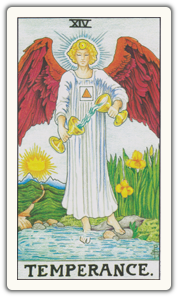
Temperance marks felt measure and blend—the moment you stop forcing extremes and learn to pour between opposites until the mix feels right, not perfect on paper.
If Temperance shows up, don't assume the cards are telling you to become endlessly patient, swallow every feeling for "peace," or wait passively while life passes by. This card is about the right dose, harmony that includes honest limits, paced progress, and direction that aligns with your deeper sense of purpose—not moderation as punishment, spiritual bypass, or a refusal to ever choose. It can feel calming and clarifying. It can also expose where you are rushing, overdoing, under-nourishing, or calling imbalance "balance." Both can be true at once.
This guide gives you a clear Temperance meaning you can use in a reading—without turning the card into a fortune-telling script or a lecture on saintly passivity.
Temperance in Plain Words
In plain words: some situations need blending, not a verdict. Temperance asks you to find the measure that actually works in your body and your life—enough rest and enough effort, enough honesty and enough gentleness, enough change and enough stability—without forcing a ledger win or pretending opposites can be crushed into one neat answer overnight. The angel pours between cups because the process matters: steady flow, tested proportion, patience that still moves.
Where Death clears what can no longer continue—endings that make room—Temperance is what you do with the cleared space: integrate, heal, mix the new with what still holds. Where Justice weighs facts and makes the clean cut after accounting, Temperance works before and after that cut in softer territory—the felt dose, the pacing, the blend that keeps you human while truth is lived. Justice asks what is fair; Temperance asks what is sustainable.
What to Notice on the Card
- Angel / alchemical figure: a mediator between realms; blending without forcing; guidance that mixes rather than divides.
- Two cups pouring: flow between opposites; the right dose; what you combine and what you leave separate on purpose.
- One foot in water, one on land: bridging feeling and practical ground; staying in both worlds without abandoning either.
- Red wings: vital warmth; spiritual energy in measured motion—not cold detachment dressed as wisdom.
- Path to sun / distant crown on horizon: soul-aligned direction; long-view patience; progress you can walk, not a single dramatic leap.
- Irises / green growth at the water's edge: renewal through steady process; life returning after change without rushing the season.
You don't need every symbol in every reading. Use the one or two that match your question.
Upright Temperance Meaning
Core
Upright Temperance says the wise move is often the measured one. Think of it as right dose, harmony, paced progress, and direction that feels aligned with who you are becoming—not with who will applaud loudest today. That may look like tapering off a habit instead of quitting in a shame spiral, rebuilding health after burnout one week at a time, letting a new relationship deepen without forcing labels, or mixing creativity with rest so the work stays alive.
This card often arrives after Death has already changed something fundamental, or while you are recovering from a season of excess, conflict, or all-or-nothing thinking. You may sense that more force will not help—the next chapter needs integration. Upright Temperance favors patience with motion: not stalling forever, but refusing to poison the blend by pouring too fast, too much, or from the wrong cup. It supports soul-aligned direction—the path that still feels true when the adrenaline fades.
Compared with Justice, upright Temperance is less about fair accounting, clear terms, and the clean cut after the scales have done their work and more about how you live inside the truth once it is named. Compared with Death, it is less about what must end and more about how you combine what remains into a life you can actually sustain.
Love
In love, upright Temperance can point to pacing that respects both hearts, rebuilding trust after rupture, blending lives without losing yourself, or affection that deepens through steady care rather than intensity alone. It may show two people learning each other's rhythms—when to talk, when to rest, how much closeness feels nourishing rather than consuming. It can also mark healing love: less drama, more honest proportion.
Read the pattern carefully. Are you moving slowly because the bond is real and needs time—or because you are afraid to name what you want? Is your partner offering genuine steadiness—or using "patience" to keep you in indefinite limbo? Upright Temperance supports measured progress with clear signals: one check-in about pace, one boundary about what feels like too much or too little, one shared ritual that marks forward motion—not a verdict that love must always feel lukewarm or that you should tolerate half-presence forever.
It can also celebrate complementary differences—the kind of relationship where opposites blend because both people adjust with care, not because one person disappears. Focus on what you can do: name the dose of contact that feels right, propose one small step toward deeper trust, or honor recovery time after conflict without treating distance as the final answer.
Work
At work, upright Temperance favors sustainable pace, cross-functional collaboration, iterative improvement, and roles that reward steady craft over constant crisis. It suits recovery from burnout, phased launches, mentoring relationships that mix experience with fresh perspective, or creative projects that need incubation time rather than forced output.
If you are building a career, upright Temperance reminds you that reputation also travels through consistency—what you can deliver month after month, how you blend ambition with health, whether your "hustle" still leaves room for judgment. If you are facing overload, ask whether you need less volume, better boundaries, or a smarter mix of tasks—not another heroic sprint that poisons the next quarter.
It can also support healing professions, design, research, hospitality, or any work where value comes from calibrated response—enough urgency to move, enough calm to get it right. Temperance here is professional rhythm, not disappearing from standards or diluting excellence into vague "good vibes."
Decision
When a decision is on the table, upright Temperance leans toward the option you can sustain—the path whose pace and proportion still make sense after the first burst of motivation. If the "yes" is only adrenaline, rescue fantasy, or fear of missing out, pause. If the "no" is only reflexive avoidance of anything that takes time, pause for a different reason. Choose the blend you can live with: enough challenge, enough support, enough clarity about what happens next.
One Next Step
Within 48 hours, take one measure action with a boundary: adjust one habit by a small, specific amount, schedule one recovery block before the next push, send one message that names the pace you need in a relationship or project, or test one proportion in your week—not a grand reinvention that collapses by Friday. Name what "enough" looks like, and what "too much" would cost.
Reversed Temperance Meaning
Core
Reversed Temperance often shows measure out of balance. Common patterns: excess or deficit, impatience, a mix gone wrong, burnout from having no measure, swinging between extremes, or calling chaos "passion" and calling numbness "peace." The card is less "you must never rest" and more "your relationship with proportion needs recalibration."
Sometimes the imbalance is internal: you pour from an empty cup until resentment leaks out, chase intensity because stillness feels unsafe, or treat every mild feeling like an emergency. Sometimes it is external: a workplace rewards only sprint mode, a partner floods you with contact then vanishes, or a wellness culture tells you to optimize every hour while your body asks for sleep. Sometimes it is misread virtue: you call self-abandonment "flexibility," or you call rigidity "discipline." Name which pattern fits before you swing to all-or-nothing conclusions.
Reversed Temperance is not permission to binge because balance failed once. It asks whether you need less, more, slower, clearer, or a different blend entirely—and whether the path you are on still points toward the sun or only toward exhaustion with a spiritual caption.
Love
In love, reversed Temperance can look like hot-and-cold pacing, merging too fast then pulling away, tolerating disrespect because you are "being patient," or staying in a lukewarm bond because any decisive move feels scary. It can also show addiction to drama, codependent caretaking, or two people who never adjust—each insisting the other should do all the blending.
Do not jump from this card alone to a verdict that the relationship is doomed or that you must force a commitment tonight. Read the pattern: where is impatience wrecking trust, and where is false patience masking avoidance? Where has the mix gone wrong—too much contact, too little honesty, too fast, too thin? Then choose one grounded action—name one limit, propose one slower step, decline one more round of chaos, or ask for one week of clear communication before you decide the blend is broken.
Work
At work, reversed Temperance can mean burnout from no boundaries, perfectionism that never ships, collaboration that dissolves accountability, or a project where every stakeholder adds one more cup until nothing holds. It may also show impatience with process—skipping steps that exist for a reason—or a culture that treats rest as weakness.
If you cannot tell whether you are integrating or diluting, you are not in Temperance integrity yet—you are stuck in a loop. For career decisions, pause before accepting a role whose pace guarantees collapse, or before calling a toxic sprint "passion." Restore measure where it helps; then decide.
Decision
When deciding, reversed Temperance warns against two traps: choosing speed because stillness feels unbearable, or choosing endless delay because any commitment might require adjustment later. Ask whether the option depends on excess, deprivation, or a mix you already know makes you sick. If any of those is true, fix the proportion gap before you commit.
One Next Step
Write three lines: what I am doing too much of, what I am doing too little of, and one small adjustment to the mix this week. If the plan is only "try harder" or "wait longer," add one concrete limit or one concrete nourishment before you pour again.
Temperance as Yes / No
As a lean only: upright Temperance often leans yes when yes means proceed at the right pace, in the right proportion, with patience that still moves—blend, integrate, adjust, then continue. Reversed Temperance often leans not yet—or no if the choice depends on excess, deficit, impatience, or a mix you already know burns you out. This is not a destiny stamp. Neighboring cards and real facts still matter.
Common Misreads
"Temperance means I should wait forever and never decide."
No. Temperance supports paced progress and soul-aligned direction—not permanent limbo or passivity dressed as spirituality. Healthy measure includes motion, check-ins, and honest limits; endless delay without purpose usually is not Temperance.
"This card is always about sobriety or giving up pleasure."
Usually no. The image is felt blend and right dose—integration, pacing, harmony that can include joy. Context can include moderation with substances or habits, but the core lesson is sustainable proportion, not joylessness.
"Reversed Temperance means I have no self-control."
Not always. It more often points to excess or deficit, impatience, a mix gone wrong, or burnout from no measure—that needs diagnosis and repair. Sometimes the next step is a smaller adjustment or clearer boundary, not shame or another extreme reset.
Mini Case Study
Question: "I left a draining job and want to freelance, but I'm tempted to say yes to every offer. Is that wise?"
Pull: Temperance, upright. What stands out: the two cups pouring and one foot in water, one on land. Read: the transition is real—you are bridging old security and new freedom. Upright Temperance is not "take nothing"; it is "pour carefully." Saying yes to everything will recreate the drain in a new costume. Next step: choose a weekly hour cap and a minimum rest block before accepting new work, then reply to one promising client with clear availability—not a blanket yes to the whole inbox. That is Temperance energy without turning opportunity into another burnout blend.
Try This Today
Use this 5-line journal after you pull Temperance:
- Question: Where do I need the right dose—not all or nothing—right now?
- Card: Temperance — upright / reversed
- What I see: (angel, two cups pouring, foot in water and on land, red wings, path to sun—pick what stands out)
- What it may mean in my situation:
- One next step in 48 hours:
Quick FAQ
What does The Temperance tarot card mean?
It points to felt measure and blend—patience that mixes opposites without forcing a ledger win. Right dose, harmony, paced progress, and soul-aligned direction. Integration, not passivity or perfectionism.
What does Temperance mean in love?
Pacing that respects both people, rebuilding trust through steady care, or blending lives without losing yourself. Upright favors measured progress and honest proportion; reversed warns against hot-and-cold chaos, false patience, or a mix that burns one person while the other coasts.
Is Temperance a yes card?
It can lean yes when yes means proceeding at the right pace and in the right proportion—blend, adjust, integrate, then continue. It is not a guarantee of outcome or a command to wait without purpose.
Is reversed Temperance always bad?
No. It is a check on excess, deficit, impatience, and burnout from no measure—often useful, not purely negative. The work is to name what is off in the mix and restore sustainable proportion.
Keep Practicing
Want a simple daily structure for pulls like this? Start with the free 7-Day Tarot Reflection Guide, or use the Opal Arc Tarot Journal Starter for printable pages that keep your questions, cards, and next steps in one place.
Continue the dictionary: previous Death Tarot Card Meaning, next The Devil Tarot Card Meaning. Contrast ledger and clean cuts with The Justice Tarot Card Meaning, practice with a first one-card tarot pull, or browse Card Meanings.