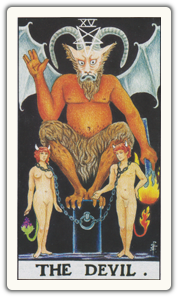
The Devil marks a bond that looks chosen—the moment appetite, material reward, or loyalty to a familiar pattern holds you tighter than you admit, even when the chains are loose enough to leave.
If The Devil shows up, don't assume the cards are calling you evil, damned, or doomed to addiction, cheating, or failure. This card is about entanglement, compulsion, and glittering attachment—not a moral verdict on your soul. It can feel exposing and clarifying. It can also sting where you have been defending a trap because it pays, pleasures, or protects you from a harder truth. Both can be true at once.
This guide gives you a clear Devil meaning you can use in a reading—without turning the card into a shame dump or a fortune-telling script.
The Devil in Plain Words
In plain words: some bonds feel voluntary until you try to change them. The Devil asks you to name what you are loyal to—habit, status, chemistry, spending, scrolling, jealousy, a role that shrinks you—and whether that loyalty still matches the life you say you want. The work is practical diagnosis, not self-flagellation. Chains on this card are often loose. The question is whether you are willing to stand up and test them.
Where The Lovers holds alignment through choice—heart, values, and consequence in the same frame—The Devil shows what happens when choice gets muddy: you stay because the attachment glitters, because leaving costs comfort, or because the pattern has become who you think you are. Lovers asks whether your yes belongs to you; Devil asks whether you still have a yes—or only a reflex. Where Temperance blends and measures with patience, The Devil tilts toward excess, fixation, and the seduction of more—more proof, more possession, more of what already narrows you.
What to Notice on the Card
- Bat wings: shadow appetite; what feels urgent in the dark; instinct that wants action before daylight honesty.
- Inverted pentagram: material fixation; priorities turned upside down; glitter, control, or comfort placed above integrity.
- Torch / flame held low: desire that feels like illumination but may only heat the trap—passion mistaken for permission.
- Adam and Eve figures with chains and tails: human bond, not a monster verdict; hooks that look like choice, chemistry, or "this is just who I am."
- Loose chains around the neck: you can leave; the bond is often maintained by habit, fear, reward, or identity—not by an unbreakable lock.
- Horned figure on a pedestal: the authority of the attachment; the pattern feels bigger than you until you name it out loud.
You don't need every symbol in every reading. Use the one or two that match your question.
Upright The Devil Meaning
Core
Upright The Devil says entanglement is worth naming honestly. Think of it as the card of glittering attachment: the job you hate but cannot leave because the title flatters you, the relationship that runs on jealousy and proof, the habit you defend because it feels like the only fast relief, the shopping or scrolling loop that steals hours while promising comfort. The bond often looks chosen. That is why it hurts to inspect—you are not only trapped by someone else; you may be cooperating with a pattern because it delivers something immediate.
This card does not call you evil. It calls the bond what it is. Upright Devil favors practical clarity over dramatic confession: what reward keeps me here, what fear makes leaving feel impossible, and which chain is actually loose if I stand up? Vitality, appetite, joy, and desire are not the problem. Polluted possession is—when wanting becomes identity, leverage, or a cage you polish instead of opening.
Compared with The Lovers, upright Devil is less about values alignment and more about attachment that outran integrity. Compared with Temperance, it is less about measured blend and more about compulsion, excess, and the seductive logic of "just one more."
Love
In love, upright The Devil can point to possessiveness, jealousy framed as passion, staying for chemistry while respect erodes, power games, or a bond built on intermittent reward—the classic loop where uncertainty feels like desire. It may show codependency, a situationship kept alive by habit, or two people reenacting an old wound because the familiarity feels like home.
Read the pattern carefully. Are you choosing each other—or choosing the hit of relief when tension breaks? Are chains made of love, or of fear of being alone, fear of starting over, or fear that no one else will want you? Upright Devil supports honest naming without a shame spiral: one boundary, one truth about what the bond costs, one test of whether the connection grows you or shrinks you. It is not a command to leave every relationship on sight. It is a command to stop calling a shrinking pattern "fate."
It can also mark intense physical chemistry that needs daylight rules—attraction is real, but attraction without respect becomes a hook. Focus on what you can do: name one behavior you will no longer call love, ask one question you have been avoiding, or take one evening off from proving, checking, or performing.
Work
At work, upright The Devil favors naming golden handcuffs: the salary that buys silence, the brand you are ashamed to describe, the team culture fueled by fear or gossip, the side hustle consuming your health, or the promotion that requires you to become someone you do not respect. It can also show material fixation—chasing status objects, metrics, or approval loops that never feel like enough.
If you are building a career, upright Devil asks whether your ambition is clean energy or compulsive proving. If you are burned out, ask what reward keeps you submitting to a pattern that shrinks you—money, identity, fear of being ordinary, fear of disappointing someone powerful. The card supports one honest inventory: what this role gives me, what it costs me, and what I pretend not to notice on Sundays.
It can also describe environments where everyone knows the system is corrosive but nobody breaks rank because the trap pays. Devil energy here is not "quit tomorrow without a plan." It is "stop calling the chain a lifestyle."
Decision
When a decision is on the table, upright The Devil leans toward caution about yeses that require you to stay chained to a shrinking pattern. If the "yes" depends on hiding, hustling for proof, spending you cannot afford, or sacrificing self-respect for a hit of relief, pause. If the "no" is only terror of losing comfort, pause for a different reason—then ask what small loosening of the chain you can test without drama.
One Next Step
Within 48 hours, name one bond in plain language: "I stay because ___." Then test one loose chain—skip one check-in, unsubscribe, block one trigger, save one purchase for 72 hours, or say one true sentence to yourself before you reply. No shame theater. One diagnostic action you can measure.
Reversed The Devil Meaning
Core
Reversed The Devil often shows waking up—or the first honest attempt to cut a chain. Common patterns: seeing the hook clearly, reclaiming choice, loosening a compulsion, setting a boundary you delayed, or refusing to call possession "love" anymore. The card is less "you are free forever" and more "the bond is losing its spell—meet the insight with action."
Sometimes the shift is internal: you finally admit the reward is not worth the cost, or you stop defending a habit because it feels embarrassing to name. Sometimes it is external: you end a situationship, leave a toxic team, delete the app, or tell the truth about money. Sometimes reversal is uneven: one chain breaks while another tightens in secret. Name which pattern fits before you perform liberation for an audience.
Reversed Devil is not automatic innocence or instant recovery. It asks you to reclaim choice with follow-through—insight without action can become a new trap: "I am so aware" as a substitute for changing behavior.
Love
In love, reversed The Devil can look like leaving a possessive dynamic, naming jealousy as a problem instead of romance, refusing to compete for crumbs, or choosing singleness over a bond that shrinks you. It can also show forgiveness with new terms—staying, but no longer calling control "care."
Do not jump from this card alone to a verdict that you must leave, or that everything is healed because you had one good talk. Read the pattern: which hook broke, which remains, and what action proves choice is returning? If you are the one loosening your grip—on checking, on punishing, on needing proof—say so plainly and show one behavior change within the week. Reversed Devil supports liberation that can be verified, not only felt.
Work
At work, reversed The Devil can mean resigning, renegotiating boundaries, stopping the side hustle that ate your life, or admitting the prestige job was a material trap. It may also show you finally tracking spending, declining performative overwork, or leaving a client whose ethics cost you sleep.
If you cannot point to one behavior that changed—not one insight slide in your journal—you may be in partial reversal only. For career decisions, pause before celebrating awareness while still signing the same contract every Monday. Reclaim choice in one visible way: update the resume, cap the hours, move one month of savings, or tell your manager one limit.
Decision
When deciding, reversed The Devil leans toward options that restore agency—paths where you are not renting your self-respect for relief. Ask whether the choice actually cuts a chain or only redecorates the cage. If the "freedom" requires a secret new obsession, or if you are fleeing without a plan and calling it healing, adjust before you commit.
One Next Step
Write two lines: "The chain I am cutting is ___" and "What I will do in 48 hours to prove it." If the second line is empty, reversal is still a mood—not a move. Pick one concrete cut: cancel, block, return, disclose, or schedule the conversation you have postponed.
The Devil as Yes / No
As a lean only: upright The Devil often leans no—or not yet—when the yes requires staying entangled, compulsive, or loyal to a pattern that shrinks you. Reversed The Devil often leans yes toward freedom, boundaries, or honest renegotiation—if you act on the insight, not only feel it. This is not a destiny stamp. Neighboring cards and real facts still matter.
Common Misreads
"The Devil means I am evil or doomed."
No. The card names entanglement, compulsion, and glittering attachment—not a moral verdict on your soul. Human figures wear the chains in the image; the work is diagnosis and choice, not shame.
"This card always means addiction, cheating, or abuse."
Not always. It can point to those patterns when context supports it—but also to status traps, spending loops, jealousy, work golden handcuffs, or any bond you maintain because it pays or pleasures. Read the situation, not the scariest keyword.
"Reversed Devil means I am completely free now."
Not automatically. Reversal often marks waking up, cutting one chain, or reclaiming choice—but freedom needs follow-through. Insight without action can become a new performance. Name what changed in behavior, not only in mood.
Mini Case Study
Question: "I keep checking my ex's social media even though I know it ruins my day. What is this habit?"
Pull: The Devil, upright. What stands out: the loose chains and the torch held low. Read: this is entanglement that looks chosen—the hit of information feels illuminating, but it reheats the trap. You are not evil; you are hooked by intermittent reward. Upright Devil supports one clean test of the chain, not a shame spiral. Next step: within 48 hours, mute or block for 30 days, tell one friend you did it so the choice is real, and write one sentence on what you were hoping each check would give you—closure, proof, revenge, or comfort. That sentence is the diagnosis. The block is the loosening.
Try This Today
Use this 5-line journal after you pull The Devil:
- Question: Where am I loyal to a pattern that shrinks me—and what reward keeps me cooperating with it?
- Card: The Devil — upright / reversed
- What I see: (bat wings, inverted pentagram, torch, chained figures, loose chains, horned figure—pick what stands out)
- What it may mean in my situation:
- One next step in 48 hours:
Quick FAQ
What does The Devil tarot card mean?
It points to a bond that looks chosen—entanglement, compulsion, material fixation, or loyalty to a pattern that narrows you. Chains are often loose enough to leave. Practical diagnosis, not "you are evil."
What does The Devil mean in love?
Possessiveness, jealousy framed as passion, chemistry without respect, or staying because the attachment glitters—even when it costs you. Upright favors honest naming and one boundary; reversed favors waking up, cutting a chain, or reclaiming choice with action.
Is The Devil a yes card?
Upright often leans no or not yet when the yes requires staying entangled or shrinking yourself. Reversed can lean yes toward freedom or honest renegotiation if you follow through—not automatic liberation.
Is reversed The Devil always bad?
No. It is often useful—seeing the hook, loosening a compulsion, reclaiming agency. It is a check that insight becomes behavior; partial awakening without follow-through can stall the real exit.
Keep Practicing
Want a simple daily structure for pulls like this? Start with the free 7-Day Tarot Reflection Guide, or use the Opal Arc Tarot Journal Starter for printable pages that keep your questions, cards, and next steps in one place.
Continue the dictionary: previous The Temperance Tarot Card Meaning, next The Tower Tarot Card Meaning. Contrast conscious choice with glittering attachment via The Lovers Tarot Card Meaning, practice with a first one-card tarot pull, or browse Card Meanings.