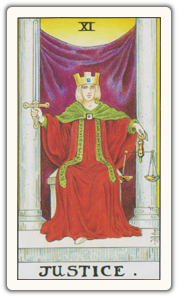
Justice marks fair accounting with clear terms—the moment truth is weighed honestly, then a clean cut is made. Not drama. Not vibes-only "karma theater." A reckoning you can name.
If Justice shows up, don't assume the cards are promising a courtroom win, cosmic punishment for someone else, or that the universe will fix everything while you stay vague. This card is about honesty, balance, consequence that matches action, and agreements everyone can understand. It can feel clarifying. It can also expose bias, uneven deals, or places you are avoiding responsibility. Both can be true at once.
This guide gives you a clear Justice meaning you can use in a reading—without turning the card into legal advice, a fate guarantee, or a script that says someone "deserves" what is coming.
Justice in Plain Words
In plain words: some situations need an honest tally before anything else moves. What was agreed? What actually happened? What matches the effort, the cost, and the impact? Justice asks you to weigh facts without flattering yourself—or scapegoating someone else—then act from that clarity. The sword is not cruelty for show; it is the clean cut after the scales have done their work.
Where The Wheel of Fortune turns through cycles you do not fully control, Justice works inside terms you can define: shared rules, timely review, and consequences that fit the action. Where The Hanged Man pauses before the verdict—suspending judgment to see from another angle—Justice is the verdict itself: truth weighed, then a decision that holds.
What to Notice on the Card
- Scales in one hand: truth weighed; both sides counted, not just the story that feels loudest.
- Raised sword in the other: the clean cut after accounting—a decision, boundary, or consequence that follows from what was measured.
- Crown: authority to judge fairly; responsibility to apply standards consistently, not only when it is convenient.
- Pillars and veil behind the figure: structure and premises—justice needs a frame (timely, under shared rules), not a mood in a vacuum.
- Square clasp / red robe and white undergarment: outer form aligned with inner clarity; public fairness rooted in private honesty.
- Direct gaze / seated posture: calm deliberation, not reactive scoring or performance outrage.
You don't need every symbol in every reading. Use the one or two that match your question.
Upright Justice Meaning
Core
Upright Justice says honest accounting is available—and probably overdue. Think of it as the capacity to name what is true, measure it against what was promised or fair, and then choose the next step that matches. That may look like reviewing a contract before you sign, closing a loop you left ambiguous, admitting your part in a conflict, or setting a boundary with terms both people can repeat back clearly.
This card often arrives when vagueness has been costing you. You may already sense the imbalance; Justice asks for the plainer skill: documentation, proportion, and follow-through. It favors consequence that fits the action—not punishment theater, and not endless "we'll see how it goes" when someone keeps breaking the same term.
Compared with The Wheel of Fortune, upright Justice is less about luck, timing you cannot steer, or cycles that turn without your input—and more about what you can account for now: the agreement, the ledger, the standard you apply on purpose. Compared with The Hanged Man, Justice is less about suspending judgment to gain a new view and more about rendering it: the pause is over; the scales have enough to weigh.
Justice works best with premises. Was the review timely? Are you using shared rules—or moving the goalposts mid-game? Practical clarity, not a lecture on cosmic law.
Love
In love, upright Justice can point to honest conversations about reciprocity, clarity about exclusivity or commitment, or naming a pattern that no longer matches what you agreed to. It may show a relationship entering a season of plain terms: what we give, what we expect, what happens when a line is crossed.
Read the pattern carefully. Are you asking for fairness—or keeping score to win? Is someone invoking "balance" to avoid repair, or are you both willing to look at facts without flinching? Upright Justice supports clear agreements: one direct question, one written boundary, one consequence you will actually uphold—not a verdict on whether love is "meant to be."
It can also celebrate partnerships built on integrity—the kind where apologies include changed behavior, not just prettier words. Focus on what you can do: state your non-negotiables, listen to theirs, or renegotiate terms before resentment hardens into a case you never wanted to try.
Work
At work, upright Justice favors contracts reviewed before you commit, feedback tied to measurable standards, and leadership that applies rules consistently. It suits negotiating pay or scope with numbers on the table, documenting decisions so memory does not rewrite them, or addressing a colleague's pattern with specifics instead of hallway rumor.
If you are building a career, upright Justice reminds you that reputation often travels through how fairly you handle terms: do you honor agreements, clarify expectations, and follow through when something is off? If you are facing conflict, ask what a proportionate response looks like—not a scorched-earth email, and not silence that lets imbalance become normal.
It can also support roles that require audit, compliance, mediation, or quality control—any work where the standard must be visible and applied the same way twice. Justice here is trustworthy process, not rigid cruelty.
Decision
When a decision is on the table, upright Justice leans toward the choice you can defend on the record—the path whose costs and benefits you have weighed honestly. If the "yes" depends on hoping someone else will ignore the mismatch, or the "no" is only spite dressed as principle, pause before you commit.
One Next Step
Within 48 hours, take one accounting action: write the terms as you understand them, list what each side contributed, schedule the conversation that clears ambiguity, or enforce one consequence you previously named but avoided. State the standard before you swing the sword.
Reversed Justice Meaning
Core
Reversed Justice often shows fairness out of balance. Common patterns: bias that favors the story you like, agreements that were never clear, consequences that do not match the action, avoiding responsibility while demanding it from others, or "justice" performed as public shaming without private honesty. The card is less "you are guilty" and more "the accounting is skewed—fix the premises before you cut."
Sometimes the imbalance is internal: you rewrite history to protect your self-image, or you punish yourself for outcomes that were not all yours to carry. Sometimes it is external: someone moves goalposts, withholds information that would change the scales, or invokes fairness only when it serves them. Sometimes it is structural: the review came too late, the rules were never shared, or power was uneven from the start. Name which pattern fits before you swing to all-or-nothing conclusions.
Reversed Justice is not permission to abandon standards or to wait forever for a perfect trial. It asks whether you need clearer terms, more honest data, or a fairer process—and whether you are hiding from a consequence you already know is due.
Love
In love, reversed Justice can look like keeping score without stating needs, silent contracts nobody agreed to, jealousy managed through surveillance instead of conversation, or breakups framed as "karma" when the real issue was never-named terms. It can also show a partner who demands loyalty while offering inconsistency, or your own habit of calling self-sacrifice "fair" while resentment builds off the books.
Do not jump from this card alone to a verdict that someone is evil or that you must accept an unfair deal forever. Read the pattern: where is bias? Where were rules never spoken? Where are you avoiding your part? Then choose one grounded action—name one term, request one clarification, decline one uneven bargain, or seek one qualified mediator if the conflict is entrenched and safety allows.
Work
At work, reversed Justice can mean favoritism, unclear expectations, blame without evidence, or policies applied only to some people. It may also show your own corner-cutting: signing without reading, overpromising to win approval, or escalating a dispute through gossip instead of documented fact.
If you cannot tell whether you are being too harsh or too lenient, you are not in Justice integrity yet—you are reacting, not weighing. For career decisions, pause before accepting a role whose terms stay vague on purpose, or before burning a bridge at peak emotion without a factual record. Restore clarity first; then act.
Decision
When deciding, reversed Justice warns against two traps: choosing the path that looks righteous because it ignores your bias, or choosing delay because one past unfair outcome convinced you that all structure is rigged. Ask whether the option requires you to punish, perform innocence, or pretend you have no part in the ledger. If any of those is true, fix the honesty gap before you commit.
One Next Step
Write three lines: what I claim is fair, what the other side would say, and one fact I have been leaving off the scales. If the gap is large, add one step toward clearer terms—a written summary, a third party, or a boundary with a consequence you will enforce.
Justice as Yes / No
As a lean only: upright Justice often leans yes when the yes means "proceed with clear terms"—sign after review, speak the honest truth, enforce the agreement you already made, or choose the option you can defend on the record. Reversed Justice often leans not yet—or yes only after you correct bias, clarify rules, or stop avoiding responsibility. This is not a destiny stamp. Neighboring cards and real facts still matter.
Common Misreads
"Justice always means you win in court."
No. Justice is about fair accounting and proportion—not a guarantee of legal victory, a judge's sympathy, or cosmic vindication. Context can include disputes, but the core lesson is honest terms and consequence that matches action, not a scripted courtroom win.
"This card is karma theater—someone is about to get punished."
Usually no. Justice asks for clarity and appropriate consequence, not spectator satisfaction or delayed revenge dressed as fate. Upright Justice favors repair and clear standards; reversed warns against bias and uneven deals—not a promise that "they'll get theirs."
"Reversed Justice means you're guilty or a bad person."
Not always. It more often points to imbalance—bias, unclear agreements, avoided responsibility, or consequences that do not fit—that needs diagnosis and repair. Sometimes the next step is clearer terms and honest data, not self-flagellation or public trial by tarot.
Mini Case Study
Question: "My roommate keeps using my groceries and saying they'll 'pay me back later.' Should I keep letting it slide?"
Pull: Justice, upright. What stands out: the scales and the raised sword. Read: the issue is not roommate morality theater—it is missing terms. Justice is not a silent scoreboard; it is a clear agreement with follow-through. You can be fair without being cruel. Next step: send a short message listing what you have covered in the last month, propose a simple split or stop-sharing rule, and name one consequence if the pattern continues (e.g., separate shelf, no longer buying shared items). That is Justice energy without turning fairness into a lecture or a permanent grudge.
Try This Today
Use this 5-line journal after you pull Justice:
- Question: Where do I need honest accounting—not vibes or scorekeeping—right now?
- Card: Justice — upright / reversed
- What I see: (scales, sword, crown, pillars and veil, square clasp, direct gaze—pick what stands out)
- What it may mean in my situation:
- One next step in 48 hours:
Quick FAQ
What does Justice tarot card mean?
It points to fair accounting with clear terms—truth weighed, then a clean cut. Honesty, balance, consequence that matches action, and agreements everyone can understand. Not karma theater or legal advice.
What does Justice mean in love?
Clarity about reciprocity, commitment, and boundaries with terms both people can name. Upright favors honest agreements and proportionate follow-through; reversed warns against bias, unspoken contracts, and avoiding responsibility while demanding fairness from others.
Is Justice a yes card?
It can lean yes when the yes means proceeding with clear terms—after review, honest conversation, or enforcing an agreement you can defend. It is not a guarantee of outcome or a courtroom win.
Is reversed Justice always bad?
No. It is a check on bias, imbalance, unclear deals, and avoided responsibility—often useful, not purely negative. The work is to name what is off the scales and restore fair process.
Keep Practicing
Want a simple daily structure for pulls like this? Start with the free 7-Day Tarot Reflection Guide, or use the Opal Arc Tarot Journal Starter for printable pages that keep your questions, cards, and next steps in one place.
Continue the dictionary: previous The Wheel of Fortune Tarot Card Meaning, next The Hanged Man Tarot Card Meaning. Contrast cycles you cannot fully steer with The Wheel of Fortune Tarot Card Meaning, pause before the verdict with The Hanged Man Tarot Card Meaning, practice with a first one-card tarot pull, or browse Card Meanings.