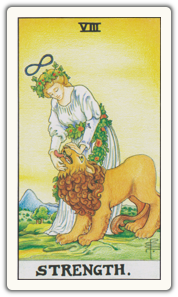
Strength marks courage that stays soft—the moment you meet instinct with patience instead of force, and discover that real power can hold a strong feeling without crushing it.
If Strength shows up, don't assume the cards are telling you to "be tougher," suppress fear, or dominate someone into compliance. This card is about gentle power, composure, resilience, and compassion with a backbone. It can feel steadying. It can also expose where you are forcing, shrinking, or treating softness as weakness. Both can be true at once.
This guide gives you a clear Strength meaning you can use in a reading—without turning the card into a fortune-telling script or a toxic positivity lecture.
Strength in Plain Words
In plain words: some challenges are not won by pushing harder from the outside. Anger, desire, fear, grief, and raw impulse are part of being human. Strength asks you to stay present with what is strong inside you—or inside someone else—and respond with timing, touch, and honest courage rather than a weapon. The work is to influence without cruelty, not to pretend you never feel anything.
Where The Chariot harnesses opposing forces through outer will and directed momentum, Strength works from the inside: breath, patience, and composure in the body. Where The Emperor builds rules and structure, Strength holds the line without needing a throne—meeting the lion at eye level instead of issuing a decree.
What to Notice on the Card
- Woman and lion: instinct met without cruelty; wild energy acknowledged, not denied.
- Infinity / lemniscate above head: ongoing self-mastery, not one heroic moment you perform once.
- Hands on the lion's jaws: influence through touch and timing, not a weapon or a chokehold.
- Flower garland / white robe: soft presentation of real power—gentleness is not the absence of strength.
- Mountain / open ground: the work happens in real terrain, not fantasy or a staged victory pose.
- Calm face / steady gaze: presence under pressure; composure you can feel, not a mask you wear for show.
You don't need every symbol in every reading. Use the one or two that match your question.
Upright Strength Meaning
Core
Upright Strength says gentle power is available. Think of it as the capacity to stay with a strong feeling—yours or someone else's—long enough to respond wisely. That may look like pausing before you send the angry text, speaking firmly without raising your volume, tending anxiety with structure instead of shame, or holding a boundary that protects you without humiliating anyone.
This card often arrives when brute force has stopped working. You may already know what needs to happen; Strength asks for the softer skill: patience, timing, and courage that does not require you to become cold. It favors resilience that includes feeling—honest fear met with steady action, not performed fearlessness.
Compared with The Chariot, upright Strength is less about winning through speed and outer drive and more about inner regulation: who holds the reins when the body wants to bolt or bite. Compared with The Emperor, Strength is less about imposing rules and more about composure inside the living moment—the law written in how you breathe before you act.
Love
In love, upright Strength can point to patience during conflict, tenderness that still has a backbone, or attraction that you do not need to punish yourself for feeling. It may show steadiness through a hard season: supporting a partner without fixing them, naming hurt without escalating, or choosing slow repair over dramatic proof.
Read the pattern carefully. Are you staying kind because you respect the bond—or because you are afraid to ask for what you need? Is someone using "calm" to avoid accountability, or are you both learning to disagree without cruelty? Upright Strength supports honest courage: one clear sentence, one boundary, one moment of presence—not a verdict on whether the relationship is destined to last.
It can also celebrate secure affection—the kind that does not need to perform dominance or chase to feel real. Focus on what you can do: listen without collapsing, speak without attacking, or give a strong feeling ten minutes before you act on it.
Work
At work, upright Strength favors composed leadership, steady delivery under pressure, and influence without intimidation. It suits finishing a demanding project without burning people out, giving feedback that is direct and humane, or staying professional when a client, colleague, or inbox triggers your temper.
If you are building a career, upright Strength reminds you that reputation often travels through how you handle friction: do you escalate, disappear, or stay present long enough to solve the real problem? If you are facing conflict, ask what a firm and kind response looks like—not a performance of toughness, and not appeasement dressed as peace.
It can also support creative or caregiving work that requires emotional stamina: holding space for others while you still protect your own capacity. Strength here is sustainable courage, not martyrdom.
Decision
When a decision is on the table, upright Strength leans toward the choice you can carry with composure—the path that does not require you to betray your values or bulldoze your nervous system. If the "yes" depends on ignoring every warning signal in your body, or the "no" is only revenge in disguise, pause before you commit.
One Next Step
Within 48 hours, take one gentle-firm action: the conversation you keep postponing, the boundary written in one clear sentence, the ten-minute pause before you reply, or the apology that includes repair—not performance. Name what you are staying steady for, and what forcing would cost.
Reversed Strength Meaning
Core
Reversed Strength often shows power out of balance. Common patterns: self-doubt that shrinks your voice, force without care, raw impulse acted on too fast, depleted courage, or "strength" performed as domination, numbness, or never admitting fear. The card is less "you are weak" and more "your relationship with strength needs recalibration."
Sometimes the imbalance is internal: you scold yourself for feeling afraid, confuse patience with passivity, or exhaust yourself trying to be unshakeable for everyone else. Sometimes it is external: someone uses intensity to control, or you meet pressure by snapping because gentleness was never modeled as safe. Sometimes it is misread softness: you call self-abandonment "love," or you call cruelty "honesty." Name which pattern fits before you swing to all-or-nothing conclusions.
Reversed Strength is not permission to suppress every feeling or to "try harder" until you break. It asks whether you need more patience, more backbone, or both—and whether the lion you are fighting is actually yours to tame.
Love
In love, reversed Strength can look like staying silent when you need to speak, exploding after weeks of "being nice," jealousy managed through control, or attraction handled with shame instead of clarity. It can also show a partner who equates love with obedience, or your own habit of equating loyalty with swallowing hurt.
Do not jump from this card alone to a verdict that you must endure everything or that the relationship is doomed. Read the pattern: where is force replacing care? Where is self-doubt keeping you in a story that hurts? Where is someone—or you—using calm as a costume for avoidance? Then choose one grounded action—name one need, decline one disrespectful demand, take one hour before you respond in anger, or ask for one session with a qualified counselor if the cycle is entrenched.
Work
At work, reversed Strength can mean burnout from over-functioning, leadership by intimidation, impulsive emails, or confidence collapse before you even begin. It may also show a culture that rewards aggression and punishes rest, or your own pattern of saying yes until resentment leaks out sideways.
If you cannot tell whether you are being too soft or too harsh, you are not in Strength integrity yet—you are swinging between extremes. For career decisions, pause before taking a role that requires you to harden into someone you dislike, or before quitting at peak emotion without a plan. Restore capacity first; then act.
Decision
When deciding, reversed Strength warns against two traps: choosing the path that looks brave because it ignores your limits, or choosing delay because one past failure convinced you that you cannot handle pressure. Ask whether the option requires you to dominate, disappear, or perform fearlessness. If any of those is true, fix the honesty gap before you commit.
One Next Step
Write three lines: what feeling is loudest right now, whether I am forcing or shrinking, and one small action that is firm and kind this week. If the plan is only white-knuckling through, add one rest or support step before you push again.
Strength as Yes / No
As a lean only: upright Strength often leans yes when the yes means "stay steady and kind-strong"—have the conversation, hold the boundary, show up with patience and backbone, respond instead of react. Reversed Strength often leans not yet—or yes only after you restore patience, capacity, or honest self-trust. This is not a destiny stamp. Neighboring cards and real facts still matter.
Common Misreads
"Strength means never feel fear."
No. Strength includes feeling fear, anger, or desire and still choosing a wise response. Toxic positivity and emotional bypass are not this card. Upright Strength meets what is real; it does not erase it.
"This card is about physical muscle or winning by force."
Usually no. The image is influence through gentleness, not gym dominance or crushing an opponent. Context can include bodily stamina, but the core lesson is composure and compassionate backbone.
"Reversed Strength means you are weak or broken."
Not always. It more often points to imbalance—self-doubt, force without care, impulse, or depleted courage—that needs diagnosis and repair. Sometimes the next step is rest and support, not trying harder.
Mini Case Study
Question: "I'm furious at my colleague's passive-aggressive email. Should I fire back today?"
Pull: Strength, upright. What stands out: the hands on the lion's jaws and the calm gaze. Read: the feeling is valid; the first draft reply is the lion, not the wisdom. Strength is not silence—it is timing. You can be clear without becoming the thing you hate. Next step: write the angry reply in a notes app, wait 24 hours, then send two sentences that name the issue and the boundary you need. That is Strength energy without turning composure into avoidance.
Try This Today
Use this 5-line journal after you pull Strength:
- Question: Where do I need gentle courage—not force or collapse—right now?
- Card: Strength — upright / reversed
- What I see: (woman and lion, infinity, hands on jaws, garland, mountain, calm gaze—pick what stands out)
- What it may mean in my situation:
- One next step in 48 hours:
Quick FAQ
What does The Strength tarot card mean?
It points to gentle power, composure, resilience, and compassion with a backbone—meeting instinct with patience instead of force. Courage that stays soft, not domination or emotional suppression.
What does Strength mean in love?
Patience during conflict, affection with integrity, and boundaries that protect without cruelty. Upright favors steady presence and honest courage; reversed warns against shrinking, controlling, or performing calm while resentment builds.
Is Strength a yes card?
It can lean yes when the yes means staying steady and kind-strong—responding wisely, holding a boundary, or showing up with patience. It is not a guarantee of outcome.
Is reversed Strength always bad?
No. It is a check on self-doubt, force without care, impulse, and depleted courage—often useful, not purely negative. The work is to name which imbalance is present and adjust.
Keep Practicing
Want a simple daily structure for pulls like this? Start with the free 7-Day Tarot Reflection Guide, or use the Opal Arc Tarot Journal Starter for printable pages that keep your questions, cards, and next steps in one place.
Continue the dictionary: previous The Chariot Tarot Card Meaning, next The Hermit Tarot Card Meaning. Contrast outer drive with inner composure via The Magician Tarot Card Meaning, practice with a first one-card tarot pull, or browse Card Meanings.