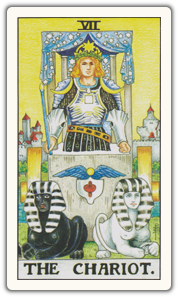
The Chariot marks will that steers—the moment opposing forces are held long enough to move forward, instead of pulling you in circles.
If The Chariot shows up, don't assume the cards are promising automatic victory, a crush on your rival, or permission to bulldoze everyone in your way. This card is about directed motion, discipline, focus, progress through alignment, and holding competing drives in the same direction. It can feel exhilarating. It can also expose where you are forcing speed without a map. Both can be true at once.
This guide gives you a clear Chariot meaning you can use in a reading—without turning the card into a fortune-telling script.
The Chariot in Plain Words
In plain words: progress needs a driver. You already have more than one pull inside you—desire and duty, ambition and fear, the part that wants to stay and the part that wants to leave. The Chariot does not erase those tensions. It asks you to steer them long enough to move. The work is to choose a direction, hold the reins with honest discipline, and act—not to pretend conflict is gone, and not to confuse aggression with momentum.
Where The Lovers names the values choice, Chariot drives the path you chose. Where The Magician sparks focused will in one decisive act, Chariot sustains that will across distance, delay, and distraction. Where Strength meets instinct with inner soft courage, Chariot works in public motion—armor on, wheels turning, the road in view.
What to Notice on the Card
- Chariot / vehicle: movement with a frame; progress needs a container, not only raw energy.
- Armor / crown: public determination; the role you step into when you commit to forward motion.
- Dual sphinxes / horses (light and dark): opposing drives that must be steered together—not silenced, not let loose.
- Wand / rod of command: will directed, not flailing; focus held in the hand that guides.
- City / walls behind: leaving a settled place; departure with purpose, not escape without aim.
- Canopy / stars: aim held above the noise of the road; direction that outlasts the first surge.
You don't need every symbol in every reading. Use the one or two that match your question.
Upright The Chariot Meaning
Core
Upright Chariot says directed will can move you forward now. Think of it as steering, not stomping: you have already named—or are ready to name—a direction, and the task is to hold competing forces in alignment long enough to travel. That may look like finishing the project you started, keeping a training schedule through a boring week, leaving a situation that no longer fits, or traveling toward a goal with fewer side arguments in your head.
This card often arrives after a choice (The Lovers) or a spark of capability (The Magician). Magician gives you the tools and the first clear act; Chariot asks what happens on the road after the ritual moment passes. You may feel two pulls at once—excitement and doubt, hunger and caution—and upright Chariot treats that as normal traffic, not a sign to stop. The question is whether you can steer without pretending the inner conflict does not exist.
Compared with Strength, upright Chariot is less about gentle inner mastery and more about outer execution: timelines, routes, public commitment, and motion others can see. Strength tames the lion with patience; Chariot harnesses opposing horses and keeps them moving in the same direction. Compared with The Emperor, Chariot is less about building the system and more about crossing the territory—progress through disciplined drive, not only law and structure.
Love
In love, upright Chariot can point to a relationship moving forward with intention: defining next steps, traveling together, choosing each other again after a crossroads, or acting on what you already know you want. It may show one person ready to show up consistently—not only in feeling, but in calendar, effort, and follow-through.
Read the pattern carefully. Are you steering toward real alignment—or racing to win an argument, prove a point, or outrun a conversation you still need? Is forward motion mutual, or is one person dragging the chariot while the other watches from the city walls? Upright Chariot supports progress when both people know where the road is heading. Focus on what you can do: name one next step, keep one promise this week, or plan one honest check-in—not a verdict on whether love is guaranteed to conquer all.
Work
At work, upright Chariot favors campaigns, launches, relocations, competitive goals, and seasons where focus wins. It suits committing to a deadline, staying on the official plan long enough to finish, leading a push without scattering your team, or taking the role that requires visible drive. It can also support travel, fieldwork, or any job where momentum and self-command matter as much as ideas.
If you are building a business, upright Chariot reminds you that inspiration is not enough after the first week—you need a route, a rhythm, and the discipline to keep steering when enthusiasm dips. If you are deciding between paths, ask which option you can actually drive for the next season without burning out or picking fights just to feel motion. Chariot rewards aligned effort, not performative hustle.
Decision
When a decision is on the table, upright Chariot leans toward the choice you can commit to and steer— the move with a clear destination, the role that requires sustained focus, the path that matches the direction you already chose in your values. If the "yes" depends on crushing someone else, ignoring every inner warning, or pretending you have no competing pulls, pause before you accelerate.
One Next Step
Within 48 hours, take one concrete motion step: block two hours for the task you keep postponing, send the message that moves the plan forward, pack one bag, or write the three-line route—where I am going, what opposes me, how I will steer this week. Name the direction before you hit the gas.
Reversed The Chariot Meaning
Core
Reversed Chariot often shows the reins slipping. Common patterns: scattered drive, aggression without aim, stalling after a strong start, losing control to one inner horse, forcing speed to avoid feeling, or winning the battle while losing direction. The card is less "you will fail" and more "motion and mastery are out of sync."
Sometimes the imbalance is external: a schedule that runs you, a boss or partner who treats your life like a race, or a situation where every push creates more chaos. Sometimes it is internal: you throttle between full speed and full stop, or you treat every obstacle as proof you must push harder. Sometimes it is mis-aim: you are moving fast toward the wrong destination because choosing felt harder than driving. Name which pattern fits before you treat stillness as failure or force as virtue.
Reversed Chariot is not automatic permission to quit every goal. It asks whether you still have the reins—and whether your current speed is steering or spinning.
Love
In love, reversed Chariot can look like hot-and-cold pursuit, arguments driven by pride, rushing commitment to avoid uncertainty, or one person forcing the relationship timeline while the other disengages. It can also show total stall: knowing what you want but refusing to act, or treating every next step as a competition instead of a conversation.
Do not jump from this card alone to guaranteed breakup or a command to chase harder. Read the pattern: where is speed replacing honesty? Where are you stopped because one inner pull has taken the wheel? Where is someone using momentum to avoid repair? Then choose one grounded action—slow one reactive message, name one boundary about pace, propose one real check-in, or take one week off from proving and listen instead.
Work
At work, reversed Chariot can mean burnout sprints, scope creep with no finish line, toxic competitiveness, travel chaos, or a project that looked powerful at launch and now has no driver. It may also show you refusing to move because one failure made you allergic to ambition—or clinging to a dead campaign because stopping feels like defeat.
If you cannot name your destination and what you are steering against, you are not in Chariot integrity yet—you are in scatter, stall, or force. For career decisions, pause before accepting a role that only rewards speed, or before abandoning a viable plan because the middle mile feels boring. Reversed Chariot often asks for tighter aim, not more noise.
Decision
When deciding, reversed Chariot warns against two traps: saying yes to prove you can win, or saying no forever because one rushed choice went badly. Ask whether the option requires you to ignore every competing value—or to stay frozen so you never have to steer. If either is true, regain the reins before you commit.
One Next Step
Write three lines: where I am actually headed, which opposing pull has taken over, and one adjustment I will make before I move again. If the plan is only "go faster," swap in one boundary, one rest stop, or one honest conversation first.
The Chariot as Yes / No
As a lean only: upright Chariot often leans yes when the yes means "commit and steer"—take the trip, finish the push, act on the direction you already chose, follow through with discipline. Reversed Chariot often leans not yet—or yes only after you regain aim and stop forcing. This is not a destiny stamp. Neighboring cards and real facts still matter.
Common Misreads
"The Chariot always means guaranteed victory."
Usually no. It can mean progress, focus, and directed will—not a promise that you win regardless of preparation, ethics, or context. Neighboring cards and real conditions still matter.
"This card tells me to crush everyone in my way."
No. Chariot is mastery and alignment, not cruelty. Upright favors disciplined motion; reversed often shows force without aim or care. Winning at someone else's expense is not the default lesson.
"Reversed Chariot means I'm lazy and will never succeed."
Not always. It more often points to scattered drive, mis-aim, stall, or aggression that needs adjustment—not a permanent character verdict. Sometimes the next step is slowing down, not quitting.
Mini Case Study
Question: "Should I take the job that requires relocating this fall?"
Pull: The Chariot, upright. What stands out: the city behind and the paired sphinxes. Read: this is not about whether you deserve adventure—it is about whether you can steer a real move once excitement fades. The opposing pulls may be security and growth, both valid. Next step: list relocation costs and support needs, talk to one person who made a similar move, and decide within 48 hours whether you can commit to the route—not whether the cards promise the job will make you happy forever. That is Chariot energy without treating motion as magic.
Try This Today
Use this 5-line journal after you pull The Chariot:
- Question: What direction am I ready to steer with honest discipline right now?
- Card: The Chariot — upright / reversed
- What I see: (chariot, armor, sphinxes/horses, wand, city walls, canopy/stars—pick what stands out)
- What it may mean in my situation:
- One next step in 48 hours:
Quick FAQ
What does The Chariot tarot card mean?
It points to directed will, discipline, forward motion, and opposing forces held long enough to move you ahead. The Chariot steers—it does not promise automatic victory.
What does The Chariot mean in love?
Intentional progress, follow-through, and moving the relationship forward with clarity. Upright favors aligned next steps; reversed warns against forced pace, hot-and-cold pursuit, or stall disguised as caution.
Is The Chariot a yes card?
It can lean yes when the yes means committing to a direction and steering it with discipline. It is not a guarantee of outcome.
Is reversed Chariot always bad?
No. It is a check on scattered drive, mis-aim, stall, and force without care—often useful, not purely negative.
Keep Practicing
Want a simple daily structure for pulls like this? Start with the free 7-Day Tarot Reflection Guide, or use the Opal Arc Tarot Journal Starter for printable pages that keep your questions, cards, and next steps in one place.
Continue the dictionary: previous The Lovers Tarot Card Meaning, next The Strength Tarot Card Meaning. Contrast spark and sustained motion with The Magician Tarot Card Meaning, practice with a first one-card tarot pull, or browse Card Meanings.