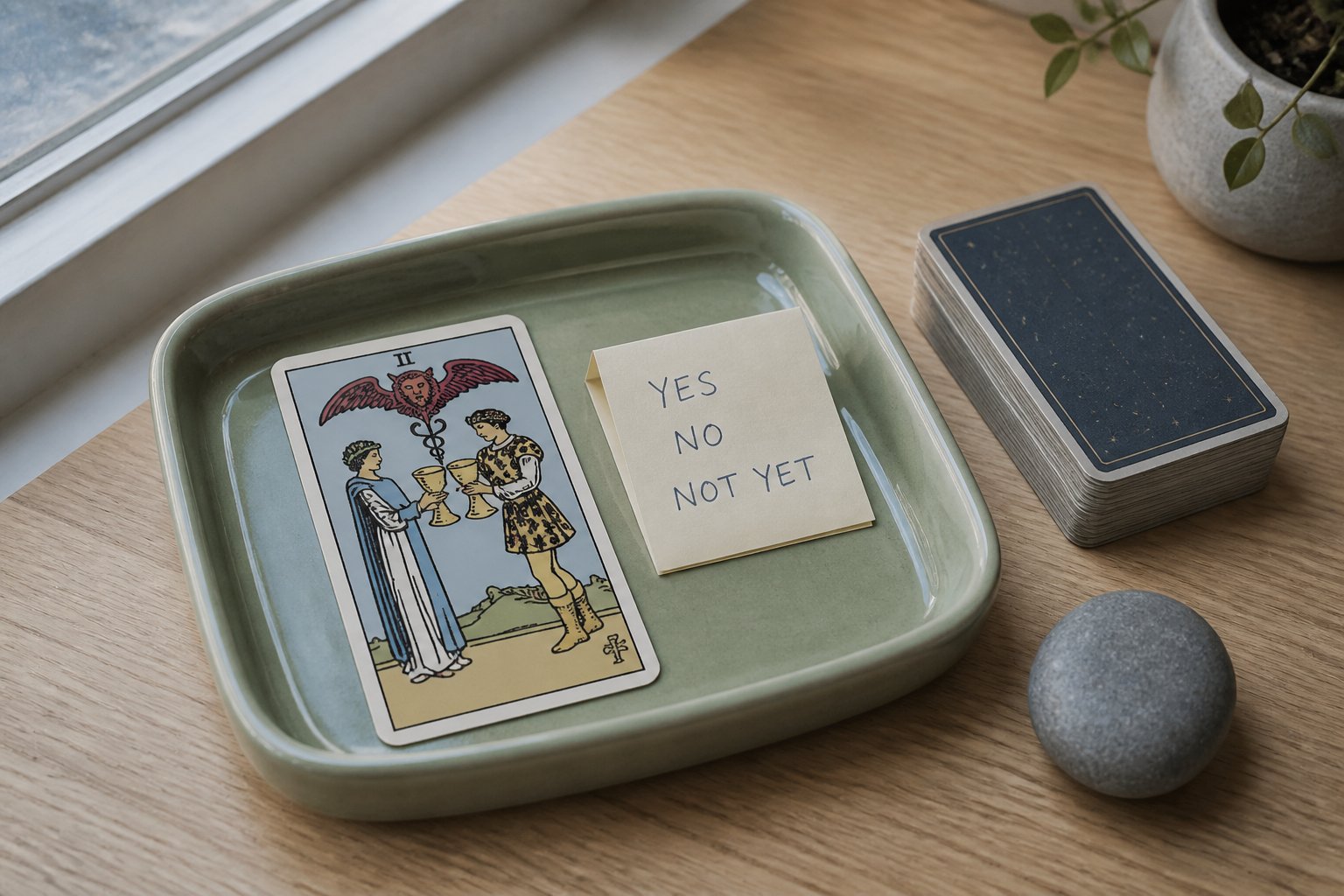
You've asked it before—probably tonight: Should I send the message? Take the interview? Rest this week instead of pushing?
You want a clean yes or no. Fair. Tarot can give you a lean for the next step—not a courtroom verdict, not sealed fate, and not an excuse to stop thinking. Here we treat yes/no as a short clarity tool: one clear question, one card, one action within 48 hours.
This guide shows when yes/no helps, how to ask better questions, how to read upright and reversed without forcing an answer, and when to close the deck and live your life.
Quick Answer
Yes/no tarot is a one-card pull on a binary question you will act on soon.
You get a lean—yes, no, or not yet—based on the card's usual tone, your question, and whether the card landed reversed. Then you write one next step, whether the lean feels encouraging or cautious.
That is the whole method. Anything beyond one pull on the same question in one sitting is usually anxiety, not practice.
Good vs Bad Yes/No Questions
Clear questions make yes/no usable. Vague or fatal questions make the deck work overtime—and you still leave without a step.
Better yes/no questions
- Love: Should I ask for clarity about plans this week?
- Work: Is now a good time to submit this application?
- Should I take the rest day I keep postponing?
- Should I have the direct conversation before Friday?
Weaker yes/no questions
- Love: Will they come back to me forever?
- Work: Will I definitely get promoted this year?
- Will everything turn out fine no matter what I do?
- What are they thinking about me right now?
Pattern: Good questions tie to something you can do or observe within a few days. Weak questions ask tarot to replace facts, medical or legal advice, or another person's inner life.
For love wording that stays grounded, use What to Ask Tarot When Confused About Love.
How to Pull
Use the same calm one-card method you would for any daily pull.
- Write one yes/no question in plain language.
- Shuffle until the deck feels mixed. If you need a steady shuffle rhythm, see How to Shuffle Tarot Cards for Beginners.
- Draw one card.
- Note whether it is upright or reversed before you interpret.
- Read the lean. Write one next step in 48 hours. Stop.
Reverse policy: Decide once whether you read reverses. If yes, a reversed card often leans not yet, blocked, or rethink the question—not automatic no. For a full method, read How to Read Reversed Tarot Cards for Beginners. If you are new, upright-only for 30 days is fine.
New to one-card pulls entirely? Start with How to Do Your First One-Card Tarot Pull, then return here when you have a binary choice.
How to Read the Lean
Think lean, not verdict. Card tone + your real situation + reversed tilt = your answer.
Upright — often a yes-lean
Cards that support forward motion, clarity, alignment, or honest action often lean yes when your question is "Should I move on this now?"
Examples from the Majors (look up your exact card in Card Meanings):
- The Fool upright often leans yes to a small, honest first step—not reckless leaps.
- The Magician upright often leans yes when you have tools ready and will use them.
- The Emperor upright often leans yes when the question is about building structure, boundaries, or follow-through.
Always ask: *Does a yes here mean action I can actually take?*
Reversed — often not yet, not automatic no
Reversed usually softens or delays the upright lean:
- Not yet — timing is off; prepare first.
- Blocked — something needs clearing before a yes makes sense.
- Rethink the question — the binary might be too small for the real issue.
Reversed The Magician might mean yes to the goal but no to doing it tonight scattered. Reversed The Emperor might mean not until power and boundaries are honest—structure before force.
"Maybe" / mixed feel
Some cards are neutral, multi-option, or about process—not a clean yes or no. That is not failure. Name it unclear lean and ask a better question, or switch to a three-card spread for context: Situation / Action / Outcome.
When you need card-specific yes/no notes, check the Yes/No section on dictionary pages—The Fool and The Magician are good models.
Mini Cases
Example only—not your reading.
Case 1 — Love decision
Question: "Should I ask for clarity about where this is going before I make summer plans?"
Card drawn: The High Priestess reversed
Lean: Not yet as a blunt confrontation. The tilt suggests you may not have listened to your own knowing—or you are asking tarot to speak before you speak. The lean is not "stay silent forever." It is "get honest with yourself first, then choose words that match what you already sense."
48-hour step: Write three sentences about what you need to know. Send one clear message—or schedule the conversation—after you can name that need without guessing their mind.
Case 2 — Work / timing decision
Question: "Should I submit the application this week?"
Card drawn: The Emperor upright
Lean: Yes-lean toward structured action—if the materials are ready and the timeline is real. Emperor favors follow-through, order, and showing up prepared—not rushing a half-finished packet.
48-hour step: Block 90 minutes to finish the application checklist, then submit—or calendar the submit time if one section still needs work.
Both cases end with action, not celebration or doom.
When to Stop Asking
Yes/no goes wrong when it becomes a loop.
Stop or pause when:
- You have asked the same question three times in one day.
- You are re-pulling until you get the answer you want.
- The question is really about forever, health, legal fate, or someone else's private thoughts.
- You already know the practical next step but want tarot to remove discomfort.
Re-pull rules that keep practice clean:
- One sitting = one pull on one question.
- If the lean is unclear, rewrite the question once—not ten pulls.
- Wait at least 24 hours before asking the same yes/no again unless facts changed.
- If anxiety is driving the shuffle, close the deck and do the human step: sleep, email, calendar, boundary.
Tarot supports agency. It does not replace it.
Quick FAQ
Can tarot answer yes or no?
Tarot can offer a lean on a clear, short-horizon question. It does not guarantee outcomes or remove your responsibility to act on real information.
Is one card enough?
For yes/no practice, yes—one card keeps the method honest. If the answer feels muddy, upgrade to three cards for context rather than pulling ten singles.
What if I get a maybe?
Name it. Write what the card is actually describing—process, timing, preparation—and either refine your question or take one preparatory step. "Maybe" often means the question was too thin.
Should I ask the same question again?
Not in the same sitting. If something materially changes—a reply arrives, a deadline moves—you can ask again the next day with a updated question. Compulsive re-asking usually signals fear, not new information.
Keep Practicing
Want a simple daily structure while you practice yes/no without turning it into a loop? Start with the free 7-Day Tarot Reflection Guide, or use the Opal Arc Tarot Journal Starter to log the question, lean, and 48-hour step in one place.
Keep building the skill stack: What to Ask Tarot When Confused About Love for relationship wording, your first one-card pull for the draw ritual, a three-card spread when binary feels too small, and How to Read Reversed Tarot Cards for Beginners when you add reverses. Browse Card Meanings for card-specific yes/no notes—including The Emperor and The Hierophant.