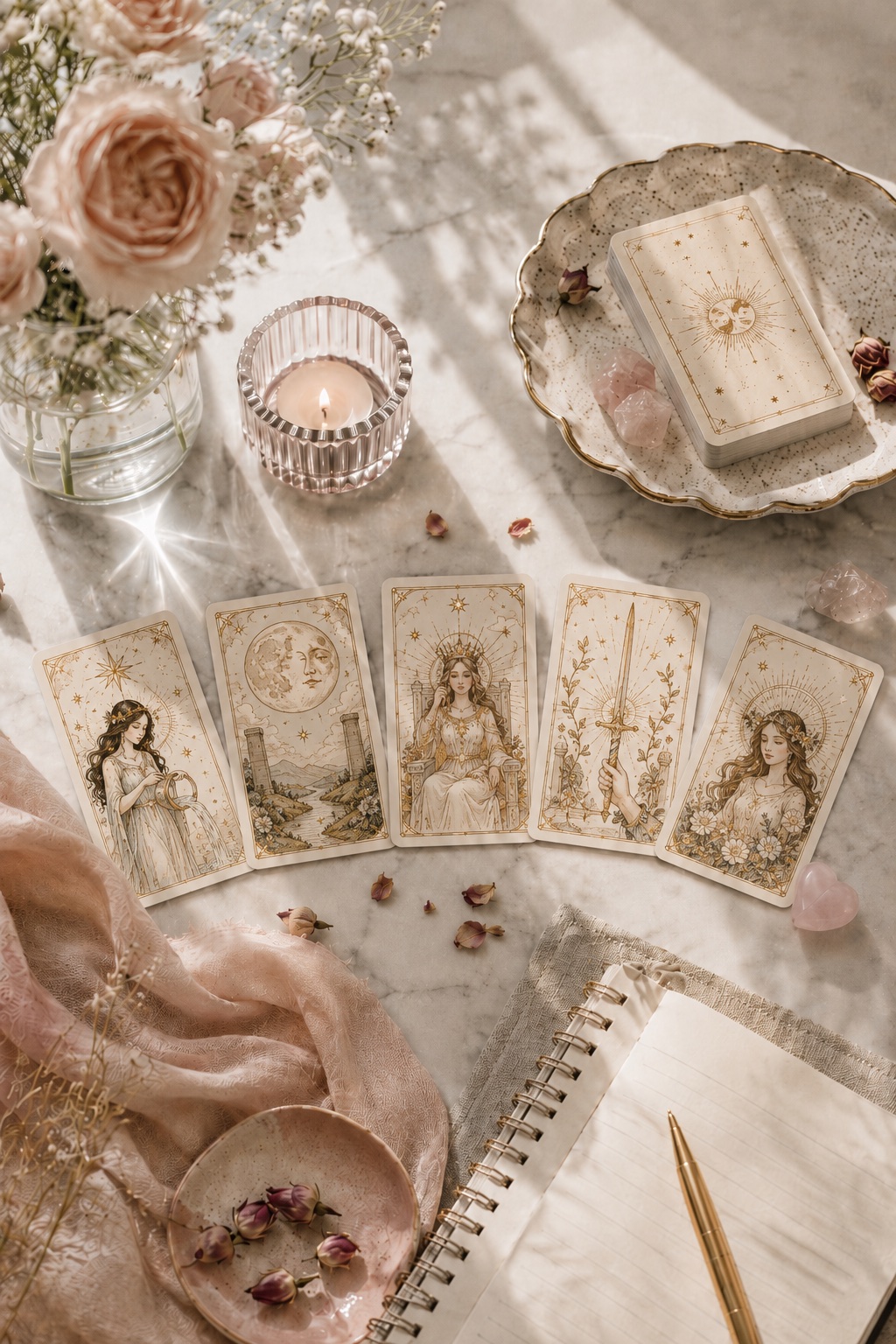
When you are confused about love, the most useful tarot questions are not usually the ones that ask someone else to decide your peace for you.
They are the questions that help you separate what is real from what you are imagining, what you need from what you are chasing, and what choice is actually yours today.
If you are in no contact, waiting for a reply, wondering whether to text, or trying to understand whether your feeling is intuition or anxiety, tarot can be a steady mirror. It can point to patterns, timing, emotional truth, and possible next steps. It should not become a way to keep asking for reassurance until one card finally says what your nervous system wants to hear.
If you want a printable place to keep working through these questions, the Love Clarity Tarot Workbook was created for moments like this: relationship uncertainty, silence, before-you-text decisions, and the gentle return to self-trust.
Why Love Tarot Questions Can Make You Feel More Confused
Love tarot becomes confusing when the question is really a request for reassurance.
Questions like What are they thinking? or Will this work out? are human. They come from the part of you that wants relief. But they can also keep the whole reading outside your own agency. You pull a card, feel better for ten minutes, then need another card because nothing in the real situation has changed.
That does not mean tarot is failing. It usually means the question is too vague, too dependent on another person's hidden feelings, or too focused on certainty before you have named what is actually happening.
A clearer love tarot question does three things:
- It separates fact from fear.
- It helps you notice the emotional pattern.
- It gives you one next step you can actually take.
Instead of asking tarot to remove uncertainty, ask it to help you meet the situation with more honesty. That is where a reading becomes useful.
Before You Ask Tarot About Love, Ground the Question
Before pulling cards, pause and write down the situation in plain language.
Not the fantasy version. Not the worst-case version. The observable version.
- We have not spoken in six days.
- They said they were unsure.
- I want to text, but I feel afraid of being ignored.
- This connection feels tender, but the communication is inconsistent.
- I do not know whether I am sensing intuition or reacting from anxiety.
This matters because tarot reads better when your question is attached to something real. If your mind is already building five possible stories, a vague question can give those stories more material. A grounded question gives the reading a stable center.
Try this small pre-reading check:
- What do I know?
- What am I assuming?
- What am I afraid might be true?
- What am I hoping is true?
- What choice is actually mine today?
If you want to build this habit beyond one reading, you may also like What to Write in a Tarot Journal, which gives a simple structure for recording cards, patterns, and next steps.
Tarot as mirror, not guarantee, means the card can illuminate the pattern you are standing inside. It does not need to become a verdict over your whole love life.
Better Tarot Questions for Love and Relationship Clarity
The best love tarot questions are not always the most dramatic ones. Often, they are the questions that help you name what is yours, what is theirs, and what the relationship is actually showing you.
When You Feel Confused
Use these when your feelings are tangled and you cannot tell whether the situation is promising, painful, unresolved, or simply unclear.
- What is the core emotional pattern in this connection right now?
- What am I seeing clearly?
- What am I avoiding because it hurts to admit?
- What part of this situation is asking for more patience?
- What part is asking for more honesty?
- What possibility is opening here?
- What is the most grounded next step available to me?
These questions work because they do not force the reading into yes or no. They give the cards room to show tone, tension, direction, and emotional truth.
When You Wonder How They Feel
It is natural to wonder what someone feels. Love is relational. But if every reading turns into an attempt to enter another person's mind, the practice can become less clarifying and more consuming.
A better approach is to ask about the connection and your response to it.
- What energy is present between us right now?
- What is being communicated clearly?
- What is being communicated indirectly?
- What am I projecting onto this person?
- What do I need to observe before deciding what their behavior means?
- What does this connection bring out in me?
- What would self-trust look like in this situation?
These questions still allow for relationship insight. They simply keep the reading from making your peace dependent on a perfect answer about someone else's private feelings.
When You Are Deciding Whether to Stay, Wait, or Move Forward
This is one of the most tender places to read from. You may not be ready to close the door, but you may also feel tired of waiting inside ambiguity.
- What is the cost of staying emotionally attached to this situation as it is?
- What is the cost of leaving too quickly?
- What am I learning about my needs here?
- What boundary would make this situation feel more honest?
- What would change if I trusted what I already know?
- What does waiting ask of me?
- What does moving forward ask of me?
- What choice supports my emotional clarity?
A useful love reading does not need to push you into a sudden decision. Sometimes its purpose is to help you see the shape of the decision more clearly.
If you want these kinds of question reframes in a printable format, the Love Clarity Tarot Workbook includes love tarot question banks and guided pages for turning vague emotional questions into clearer ones.
What to Ask Tarot During No Contact
No contact can feel calm on the outside and very loud on the inside.
There may be silence, but your mind keeps moving: Should I wait? Are they thinking of me? Was the connection real? Should I reach out? Am I healing or pretending not to care?
During no contact, tarot is most helpful when it supports emotional steadiness. The aim is not to keep checking the other person through the cards. The aim is to understand what the silence is doing inside you, what it is revealing, and what would help you return to yourself.
Try these no contact tarot questions:
- What is this silence revealing about my emotional needs?
- What am I learning about the way I respond to uncertainty?
- What do I miss about them, and what do I miss about the version of myself I felt with them?
- What part of me is seeking reassurance?
- What boundary would help me feel more steady?
- What is one thing I can do today that is not centered on waiting?
- What would self-respect look like in this no contact period?
- What pattern am I being invited to notice before I reach out again?
A no contact reading can be powerful when it moves you from What are they doing? to What is this pause asking me to understand?
That shift does not erase your feelings. It gives them somewhere wiser to go.
What to Ask Tarot Before You Text Them
Before texting someone, especially in a fragile or uncertain love situation, your intention matters.
A message can be an honest bridge. It can also be a way to seek relief from discomfort. Neither makes you wrong. But it helps to know which one is happening before you press send.
Before you text, ask tarot:
- What is my true intention in reaching out?
- Am I seeking connection, clarity, closure, reassurance, or control?
- What do I need to be prepared for if they do not respond?
- What tone would protect my dignity and honesty?
- What am I hoping this message will fix?
- What boundary should I keep even if I send the message?
- What would be a simple, self-respecting version of what I want to say?
You can also pull one card for the energy of sending and one card for the energy of waiting. The point is not to make the card decide for you. The point is to see what each option asks of your nervous system, your self-trust, and your emotional clarity.
For no contact, silence, and before-you-text moments, the Love Clarity Tarot Workbook gives you guided reflection pages to pause, clarify your intention, and return to self-trust before acting.
Intuition vs. Anxiety in Love Tarot Readings
One of the hardest parts of love confusion is not knowing whether you are sensing something real or reacting from fear.
Intuition usually feels quiet, direct, and simple. It may not be comfortable, but it does not keep demanding proof. Anxiety often feels urgent, looping, and hungry for certainty. It asks the same question in slightly different forms. It wants another card, another sign, another interpretation.
A helpful tarot question here is:
- Is this feeling asking for attention, or is it asking for reassurance?
You can also ask:
- What does my intuition know calmly?
- What is anxiety trying to protect me from?
- What fact am I ignoring?
- What story am I adding?
- What would I do if I did not need certainty first?
- What helps my body feel steady enough to choose clearly?
Do not shame yourself if anxiety is present. Love uncertainty touches attachment, hope, memory, longing, and fear. The goal is not to become perfectly calm before you read. The goal is to notice what state you are reading from, so the cards do not become part of the spiral.
When to Pause Before Pulling More Cards
There is a moment when pulling another card stops bringing clarity.
You might notice it when you ask the same question again, hoping for a softer answer. Or when a reading makes you feel temporarily relieved, then more anxious afterward. Or when you are no longer listening to the cards, only searching for confirmation that the outcome you want is still possible.
That is the moment to pause.
Not forever. Just long enough to return to your body and your facts.
Pause before pulling more cards if:
- You have asked the same question several times.
- You feel more activated after each reading.
- You are using tarot to avoid sending, not sending, grieving, resting, or choosing.
- You only want the card to reassure you.
- You are ignoring what the real-world situation has already shown you.
Instead of pulling again, journal:
- What answer am I hoping to receive?
- What answer am I afraid to receive?
- What do I already know, even if I do not like it?
- What would help me feel safe for the next hour?
- What is one grounded next step that does not require their response?
This is where a love tarot practice becomes more than card pulling. The reading should help you return to yourself. It should not become a loop that keeps you suspended outside your own life.
You can explore more tarot and symbolic practice pieces in the Tarot archive.
What to Do After a Love Tarot Reading
After a love tarot reading, do not rush to interpret everything perfectly.
Write down the cards, your first impression, and the emotional tone of the reading. Then separate three things:
- What the card showed.
- What you felt.
- What you can choose.
For example, a card may show waiting, uncertainty, tenderness, conflict, desire, restraint, or transition. Your feeling may be hope, grief, calm, fear, or recognition. Your choice may be to wait one day, write the unsent message, ask for clarity, stop checking, make plans with a friend, or return to your own routine.
This is how a reading becomes useful. Not because it removes the unknown, but because it helps you meet the unknown with more honesty.
A simple after-reading practice:
- Name the main insight.
- Name the emotional pattern.
- Name one fact.
- Name one boundary.
- Name one next step.
Then close the reading. Let it become part of your life, not a place where you keep circling.
A Printable Way to Keep Working With These Questions
If your love readings often happen during silence, uncertainty, before-you-text moments, or the ache of not knowing what someone feels, it helps to have a structure that keeps the reading grounded.
Final Reflection
When you are confused about love, the most useful tarot question is rarely the one that tries to solve another person.
It is the one that helps you return to the center of your own experience.
- What do I know?
- What am I imagining?
- What is this showing me?
- What choice belongs to me?
- What next step supports my self-trust?
Love can be mysterious without becoming chaotic. A tarot reading can be spiritual without becoming ungrounded. You are allowed to want insight, timing, possibility, and emotional clarity. You are also allowed to pause, breathe, and choose slowly.
Let the cards open a mirror. Then let your life, your body, your boundaries, and your self-trust help you decide what comes next.
Love Tarot Questions: FAQ
What should I ask tarot when I'm confused about someone?
Ask questions that help you separate fact, fear, hope, and emotional pattern. Instead of asking only what the other person feels, try: What do I know for sure? What am I imagining? What is this connection showing me? What next step supports my self-trust? These questions keep the reading grounded while still allowing insight into the relationship dynamic. They also help you avoid turning tarot into a reassurance loop when what you really need is clarity.
What are good tarot questions for love and relationships?
Good love tarot questions focus on insight, emotional clarity, timing, possibility, and your own agency. Try asking: What pattern is present in this connection? What am I learning about my needs? What boundary would make this feel more honest? What is the most grounded next step? You can still explore romance, attraction, uncertainty, and relationship direction, but the strongest questions help you understand the situation without handing your peace entirely to another person's choices.
What should I ask tarot during no contact?
During no contact, ask questions that bring you back to yourself rather than keeping all attention on the other person. Helpful questions include: What is this silence revealing about my needs? What am I learning about uncertainty? What part of me is seeking reassurance? What would self-respect look like right now? A no contact reading can help you understand the pause, but it should also help you care for your own energy, boundaries, and next step.
Should I ask tarot if someone will return?
You can bring that longing to a reading, but it is often more useful to soften the question. Instead of trying to force a fixed answer, ask what the current pattern suggests, what timing or emotional readiness may be involved, and what you need to know while you wait or move forward. Try: What is the energy around reconnection? What would need to be different for this to feel healthy? What choice supports my self-trust today?
How do I know if it is intuition or anxiety in a love reading?
Intuition often feels quiet, clear, and steady, even when the message is uncomfortable. Anxiety tends to feel urgent, repetitive, and hungry for more proof. In a love reading, ask: What does my intuition know calmly? What is anxiety trying to protect me from? Then look at the facts of the situation. A grounded tarot practice does not require you to ignore fear; it helps you understand fear without letting it make every decision for you.
What should I do after a love tarot reading?
After a love tarot reading, write down the cards, your first impression, and one grounded next step. Separate what the card showed from what you felt and what you can actually choose. This keeps the reading from becoming abstract or overwhelming. You might decide to pause before texting, ask for clarity, respect a boundary, rest, or return to your own routine. The most helpful reading is one that leaves you more honest, more steady, and more connected to yourself.