If you can already pull one card, you are ready for the next skill: reading three cards as a short story.
One card is a flashlight. Three cards are a small map. Same deck. Same notebook. More relationship between what you see.
This guide shows you when to use three cards, how to lay them out, how to read Past / Present / Future without turning Future into a destiny stamp, and how to practice today.
If you have not done a single-card pull yet, start with How to Do Your First One-Card Tarot Pull. Come back here when one card feels clear—and a little too thin for the question you are holding.
When to Use 3 Cards vs 1 Card
Stay with one card when
- You want a daily check-in ("What energy is here today?").
- You need one focus before a meeting, message, or rest.
- You are still learning to notice symbols without panic.
Upgrade to three cards when
- The situation has a before / now / next shape.
- You need a choice with context, not only a mood.
- One card keeps answering "tone," but you need "what relates to what."
Simple upgrade rule: If you can state your question in one line and still feel you need history + present pressure + a likely path if nothing changes, use three cards. If you only need a spotlight, stay with one.
Before You Draw: Question Quality
Clear questions make three-card readings usable. Fuzzy questions make three cards feel louder—and more confusing.
Better questions
- What pattern am I carrying from the past into this decision?
- What needs my attention in this conversation right now?
- If I keep my current approach, what trajectory am I on—and what is one adjustment?
- What is the situation, what action is available, and what outcome that action supports?
Weaker questions (for this practice)
- Will everything work out forever?
- What is my whole future with this person?
- Just tell me yes or no and skip the middle.
- What are they secretly thinking in every detail?
You can still ask about love, work, or timing. Keep the question tied to something you can observe or do. For love wording help, see What to Ask Tarot When Confused About Love.
Write the question down before you shuffle. If you want a calm shuffle method, use How to Shuffle Tarot Cards for Beginners. A simple reset is enough if the deck feels sticky—see How to Cleanse Tarot Cards for Beginners—then return to the question.
How to Lay Out the Cards
Work left to right. Keep it physical and boring on purpose.
- Clear a small strip of table space.
- Hold your written question.
- Shuffle until the deck feels mixed and you feel ready to stop.
- Draw three cards.
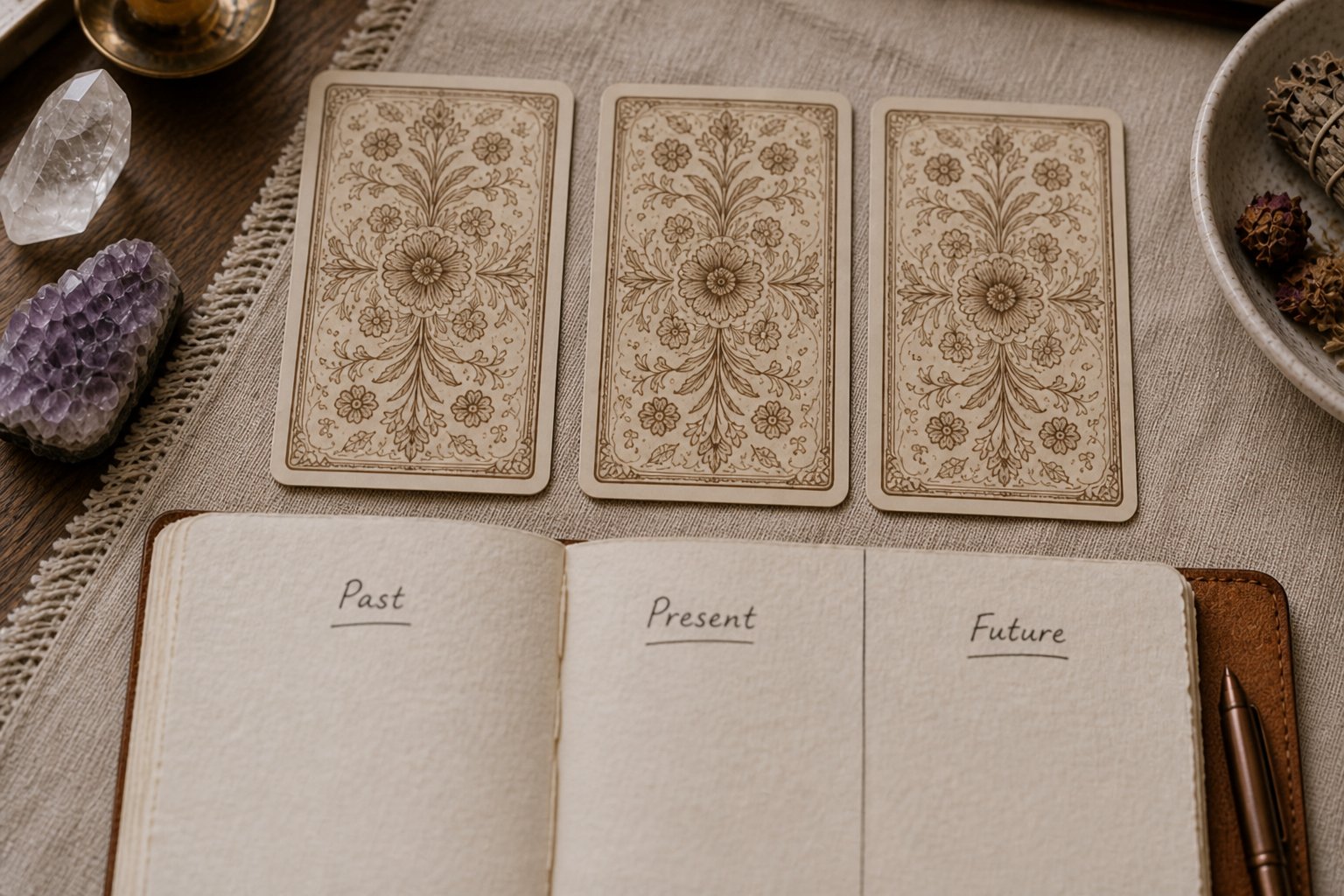
- Place them in a row: left = Position 1, middle = Position 2, right = Position 3.
- Turn them face up only after all three are placed (or turn as you place—pick one method and keep it consistent).
Do not rearrange mid-read to "make a nicer story." Notice first. Meaning second. Next step last.
Classic Layout: Past / Present / Future
This is the layout most beginners search for. It is useful. It is not the only layout. And Future is not a sealed fate stamp.
Position 1 — Past
What is coloring the situation from before now: a habit, a prior choice, an old story, unfinished business.
Ask: What am I still carrying into this?
Position 2 — Present
What is active right now: the pressure, the resource, the choice point.
Ask: What is asking for attention today?
Position 3 — Future (trajectory)
If nothing meaningful changes—if you keep the same approach—what direction is most likely to keep unfolding?
Ask: What path am I already on, and what one adjustment would change the weather?
That reframing matters. Future here means trajectory / if nothing changes, not "this will happen no matter what you do." Neighboring cards, real facts, and your next action still matter.
When a card is unclear, look up one plain-language entry in Card Meanings—for example The Fool, The Magician, The High Priestess, or The Empress—then return to the row and reconnect the three.
Two Alternate Layouts (Use When They Fit Better)
1) Situation / Action / Outcome
- Situation: What is happening.
- Action: What you can do.
- Outcome: What that action tends to support (still conditional, not destiny).
Use this when you are deciding, not reminiscing.
2) You / Them / Relationship
- You: Your side of the pattern.
- Them: The other person's pattern as it shows in the dynamic (not a mind-reading verdict).
- Relationship: What the connection itself is asking for.
Use this for relationship questions when Past / Present / Future feels too timeline-heavy. Keep "Them" about observable dynamics, not surveillance.
You do not need Mind / Body / Spirit today. Two strong alternates are enough.
How to Read the Three Cards as One Sentence
This is the skill that separates a beginner who lists keywords from a beginner who can practice.
Try this template:
Given [Past/Situation], I'm in [Present/Action/You], so if nothing changes I'm heading toward [Future/Outcome/Relationship]—therefore my next step is [one action].
Rules that help:
- Notice 1–2 symbols on each card before you open a book.
- Let one card modify another (Present can soften Past; Action can redirect Outcome).
- Write one sentence, not three separate essays.
- End with a 48-hour next step you can actually do.
If journaling feels sticky, use the structure in What to Write in a Tarot Journal.
Reversals (keep it light)
If you are new, upright-only is fine. Read all cards upright until the one-sentence skill feels steady.
If your deck includes reversals and you want to use them, decide before you shuffle and stay consistent for the whole spread. Reversed often means "the upright theme is blocked, delayed, exaggerated, or turned inward"—not automatic disaster. A full reversals guide can be its own article later; do not turn this practice into that rabbit hole tonight.
Worked Mini Example (Labeled Practice)
Example only—not your reading.
Question: "What pattern am I bringing into this job decision, and what trajectory am I on if I keep hesitating?"
Layout: Past / Present / Future
Cards drawn (example):
- Past — The Magician
- Present — The High Priestess
- Future (trajectory) — The Empress
Notice first: Magician's table tools; High Priestess's veil; Empress's wheat and care.
One-sentence read: "Given that I already have skills on the table (Magician), I'm in a pause that needs honest listening rather than more performance (High Priestess), so if nothing changes I'm heading toward growth that only happens if I actually tend something real (Empress)—therefore my next step is to send the clarifying email I keep rewriting and schedule one recovery evening so I can sustain the work."
That is a three-card practice: relationship between cards, trajectory language for Future, one next step. Look up each card in Card Meanings if you need a symbol refresh—then return to the sentence.
Common Mistakes
"The only real three-card spread is Past / Present / Future."
No. It is the classic search layout. Situation / Action / Outcome and You / Them / Relationship are often clearer for decisions and relationship questions.
"Read each card alone, then stop."
Three cards are a sentence. If you only collect three keyword piles, you miss the upgrade from one-card practice.
"The Future card means it is destined."
No. In this method, Future means trajectory if nothing changes. Your next step is part of the reading.
Try This Today
Do one three-card practice this week.
- Write one clear question.
- Choose a layout: Past / Present / Future or Situation / Action / Outcome.
- Shuffle and lay three cards left to right.
- Notice 1–2 details on each card.
- Write one sentence with the template above.
- Write one next step for the next 48 hours.
Optional journal lines:
- Question:
- Layout:
- Cards (1 / 2 / 3):
- What I see:
- One sentence:
- Next step in 48 hours:
Quick FAQ
What is the best 3-card tarot spread for beginners?
Past / Present / Future is the most searchable starter. For decisions, Situation / Action / Outcome is often cleaner. Pick one and practice it three times before collecting more layouts.
Do I need reversals for a three-card spread?
No. Upright-only is a solid beginner method. If you use reversals, decide before you shuffle and keep the rule consistent.
Is the Future card fixed?
In this guide, no. Future is read as trajectory / if nothing changes. Action can redirect the path.
How long should a three-card reading take?
About 10–15 minutes for a practice pass: question, lay out, notice, one sentence, one next step. Longer is fine; panic scrolling through every symbol is not required.
Keep Practicing
Want a simple daily structure while you build from one card to three? Start with the free 7-Day Tarot Reflection Guide, or use the Opal Arc Tarot Journal Starter for printable pages that keep your questions, cards, and next steps in one place.
Keep the dictionary open while you practice: Card Meanings. Refresh the basics with your first one-card pull, then come back and run tonight's three-card row again tomorrow with a sharper question.