
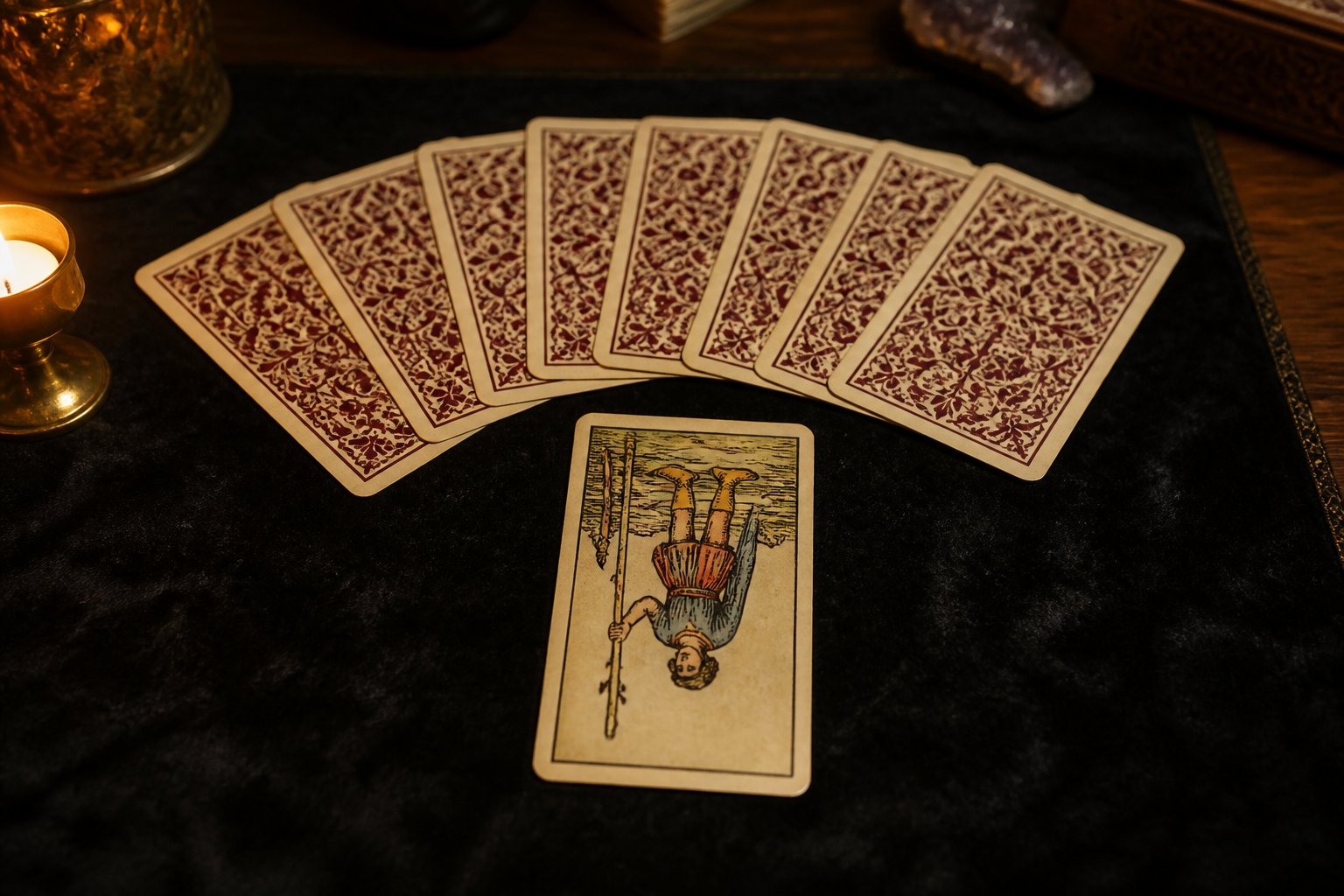
You turned a card and it landed upside down. Your stomach dropped. You searched "reversed tarot meaning" and found a wall of warnings.
In real practice, a reversed card is usually a tilt in the upright story—blocked, delayed, internalized, or overdone—not a separate evil card. It is one more detail in the same image, not a verdict that the reading failed.
This guide gives you a method you can use tonight. You will leave with three beginner-safe ways to read a reverse, a clear policy on whether you need reverses at all, and a short practice pull—not a fear list.
Quick Answer
Reversed means the card's upright theme is present but tilted: stuck, delayed, turned inward, exaggerated, or running in the background instead of the foreground.
What it is not:
- Automatic bad news
- A guaranteed opposite keyword
- Proof that you shuffled wrong
- A reason to pull again until something lands upright
Most readers treat reversed as "where is this energy harder to access, louder than helpful, or happening inside rather than out loud?" That question keeps the reading practical.
Do You Have to Read Reverses?
No. Reverses are optional.
Many beginners read upright-only for the first month while they learn to notice symbols and write one clear next step. That is a valid method, not a shortcut.
If you do want to read reverses, pick a policy and keep it for about 30 days:
- Read reverses: Turn cards as they fall; note upright vs reversed in your journal.
- Ignore reverses: Read every card as upright until the one-card habit feels steady.
Consistency matters more than perfection. Switching rules mid-reading—or mid-week—makes every reverse feel like a crisis.
When beginners should skip reverses for a month:
- You are still learning what upright symbols look like on your deck.
- Reverses trigger panic more than curiosity.
- You are doing your first one-card pulls and want one skill at a time.
You can add reverses later. The deck will still be there.
Three Beginner-Safe Methods
Pick one method per reading. Do not stack all three and argue with yourself.
Method 1: Upright meaning + "Where is this stuck, overdone, or delayed?"
Start with the upright theme you already know—or look it up in Card Meanings. Then ask where that theme is hard to reach, running too hot, or waiting on timing.
Tiny example — The Magician reversed:
Upright Magician is focused will, tools on the table, words that match action. Reversed, the same card often points to scattered effort, tools unused, or talk without follow-through. You are not reading a different card. You are asking: *Where is my ability to act blocked or misdirected?*
Use Method 1 for most daily pulls. It stays close to the image and avoids keyword flipping.
Method 2: Same theme turned inward
Reversed can mean the upright energy is private, unexpressed, or self-directed—happening inside you rather than in the room.
Tiny example — The High Priestess reversed:
Upright High Priestess honors inner knowing and quiet observation. Reversed, you might be ignoring your gut, oversharing before you have listened, or looking for answers outside when the next step is internal. The theme is still Priestess. The direction turned inward—or got muffled.
Use Method 2 when the question is about confidence, voice, boundaries, or "I know something but I am not acting on it."
Method 3: Opposite-lean (binary questions only)
Sometimes a reversed card leans opposite when your question is truly either/or and the image clearly shows blockage.
Tiny example — The Empress reversed for "Should I launch this week?":
Upright Empress supports growth, care, and bringing something to form. Reversed might lean "not yet—nurture the foundation first" or "you are forcing growth without support." That is a timing lean, not a permanent no.
When NOT to use Method 3:
- The question is open-ended ("What do I need to know about my career?").
- You do not know the upright meaning yet—learn upright first.
- The reverse fits Methods 1 or 2 more cleanly than a simple opposite.
For card-by-card upright and reversed notes, use the dictionary—The Magician, The High Priestess, and The Empress are strong starters.
How This Shows in Love and Work
Reverses show up the same way in every area: same card, same tilt language.
Love (short):
Reversed often marks something unspoken, delayed, or running in the background—attraction without follow-through, care turned inward, boundaries that wobble. Read what you can observe, not what someone is "secretly thinking." For clearer love questions, see What to Ask Tarot When Confused About Love.
Work (short):
Reversed often marks blocked momentum, overwork, misaligned leadership, or a skill you have but are not using. Ask: *What is stuck, internalized, or running too hot in this role or decision?* Then name one action in the next 48 hours.
Reversed does not mean the relationship or job is doomed. It means the upright theme needs a more honest look.
Common Mistakes
1) "Reversed always means bad."
No. Reversed means tilted—delayed, internal, blocked, or overdone. Some reversed cards point to rest, privacy, or slowing down something that was moving too fast. Panic closes the reading; curiosity opens it.
2) "Always use the opposite keyword."
If upright Strength is steady courage, reversed is not automatically "weakness" in every spread. It might be self-doubt, force without patience, or courage you have not claimed yet. Method 1 and 2 usually serve you better than a reflex opposite.
3) "Pull again until the card is upright."
Replacing a reversed card teaches you to distrust the deck—and your own attention. The card landed that way. Read it with the method you chose, write one next step, and stop. If you want a calmer draw ritual, review How to Shuffle Tarot Cards for Beginners and return to the same question once—not five times.
Mini Practice: One Card With Reverse Allowed
Try this once this week.
- Question: "Where is my energy stuck or turned inward right now?"
- Shuffle using your usual method. Allow reverses. Draw one card.
- Notice: Name two details on the card before you look anything up.
- Method: Pick Method 1 or 2. Write two sentences: upright theme + where it tilts.
- Next step: One action in the next 48 hours you can actually do.
Optional journal lines:
- Question:
- Card: — upright / reversed
- What I see:
- What it may mean in my situation:
- One next step in 48 hours:
For a fuller journal structure, see What to Write in a Tarot Journal.
Quick FAQ
Do I need to read reversed cards?
No. Upright-only is a complete beginner method. If you read reverses, choose one approach from this guide and keep it for about 30 days.
Does reversed mean no?
Not automatically. In yes/no pulls, reversed often leans not yet, blocked, or rethink the question—not a permanent rejection. See Yes or No Tarot for Beginners for how to read a lean without forcing a verdict.
What if I can't tell upright from reverse?
Some cards look nearly the same both ways. If you truly cannot tell, read upright for that pull and note the ambiguity. You can also use a deck with clear top/bottom art until you feel confident.
Should I flip the card back upright?
For practice, most readers keep the card as it landed while they write. Flipping mid-read can erase the detail you are learning to notice. Read it reversed, write your notes, then move on.
Keep Practicing
Want a simple daily structure while you build reverse skills? Start with the free 7-Day Tarot Reflection Guide, or use the Opal Arc Tarot Journal Starter for printable pages that keep questions, cards, and next steps in one place.
Keep the dictionary open: Card Meanings. Refresh upright and reversed notes in The Magician, The High Priestess, and The Empress. Pair this with your first one-card pull, a three-card spread when you want more context, and a steady shuffle in How to Shuffle Tarot Cards for Beginners.