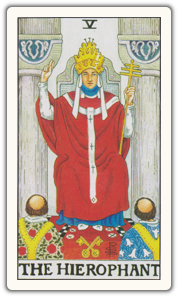
The Hierophant marks wisdom that travels through form—the moment teaching, vows, and shared practice give you a container you can actually enter, learn inside, or question with eyes open.
If The Hierophant shows up, don't assume the cards are ordering you to marry, join a church, or obey a guru. This card is about guidance, tradition as support, ethical teaching, commitment to a path, and learning inside a real container. It can feel grounding. It can also expose where ritual has replaced relationship. Both can be true at once.
This guide gives you a clear Hierophant meaning you can use in a reading—without turning the card into a fortune-telling script.
The Hierophant in Plain Words
In plain words: some wisdom is meant to be shared—not only felt in private. Teachers, mentors, ceremonies, study groups, professional ethics, and vows exist so you do not have to invent every step alone. The work is to find or build a container you can trust, not to perform devotion you do not feel, and not to confuse costume with substance.
In many decks this figure is also called the High Priest or Pope; Opal Arc uses Hierophant to match the Rider–Waite–Smith name, but the job is the same: transmitted teaching in shared language. Where The High Priestess holds inner knowing behind the veil, Hierophant brings knowledge into a form others can join. Where The Emperor builds personal and systemic authority, Hierophant carries lineage—what gets passed hand to hand.
What to Notice on the Card
- Triple crown / papal tiara: layered office; teaching with rank and responsibility, not casual opinion.
- Two pillars: threshold of formal sacred space—echoes the Priestess pillars, but this card's job is shared entry, not private listening.
- Raised hand / blessing gesture: transmission; permission and orientation—"here is how we begin."
- Crossed keys: access to doctrine; unlock shared meaning together, not hoard it.
- Two acolytes: lineage; learning is relational—you are not the only student in the room.
- Robes / formal seat: institution and costume of trust—or, when reversed, costume without substance.
You don't need every symbol in every reading. Use the one or two that match your question.
Upright The Hierophant Meaning
Core
Upright Hierophant says guidance through form is available. Think of it as a doorway, not a cage: a class, a mentor, a tradition, a professional code, a ceremony, or a community practice that helps you learn faster than improvisation alone. That may look like enrolling in structured training, asking a senior colleague to show you the real workflow, returning to a spiritual practice that still feeds you, or naming a commitment out loud so others can witness it.
This card often arrives when private intuition (The High Priestess) has done its job and you need shared language. You may already know the feeling; Hierophant asks for the sentence, the ritual, the syllabus, or the vow that makes the knowing usable with other people. It favors ethical teaching—wisdom offered in a form that can be tested, questioned, and repeated.
Compared with The Emperor, upright Hierophant is less about who holds power and more about what gets transmitted: doctrine, craft, rites, standards, and the relational field of learning. Emperor sets the law; Hierophant teaches how to live inside a path with others.
Love
In love, upright Hierophant can point to commitment ceremonies, meeting each other's people, shared values, or a relationship that takes tradition seriously—not as performance, but as a public language for care. It may show readiness to define the bond: exclusivity, marriage talks, moving in with eyes open, or aligning on what faith, family, or ethics mean for you both.
Read the pattern carefully. Are you choosing form because it matches real values—or because visibility feels safer than intimacy? Is a couple honoring a shared path, or is one person hiding behind "what we are supposed to do"? Upright Hierophant supports mutual consent inside a container both people understand. Focus on what you can do: one honest conversation about values, one meeting with a counselor or mentor if needed, one clear statement of intent—not a verdict on whether wedding bells are destined.
Work
At work, upright Hierophant favors apprenticeships, certifications, onboarding, mentorship, and professional ethics. It suits learning the official process before you improvise, joining a guild or trade community, or taking compliance and standards seriously because they protect clients and colleagues. It can also support teaching: you have enough experience to pass on a method without pretending you invented the field.
If you are building a business, upright Hierophant reminds you that trust often travels through visible form: clear contracts, transparent policies, credentials that match your claims, and a brand promise you can repeat without drift. If you are deciding between paths, ask which option includes a teacher, cohort, or code of practice that would genuinely sharpen you—not only a badge for your bio.
Decision
When a decision is on the table, upright Hierophant leans toward the choice you can explain in shared language: the program with a syllabus, the relationship with aligned values, the role with ethical guardrails, the path you would not be ashamed to describe to a mentor. If the "yes" requires hiding how you learned what you know—or breaking vows you already made—pause before you sign.
One Next Step
Within 48 hours, complete one concrete learning or commitment action: book the class, email the mentor, write the values list with your partner, or read the policy you skipped. Name the container you are entering, and what honest participation looks like.
Reversed The Hierophant Meaning
Core
Reversed Hierophant often shows form going hollow. Common patterns: dogma without heart, ritual without relationship, a bad or misaligned teacher, rebellion without a replacement path, conformity that erases your voice, or spiritual materialism—collecting credentials to avoid living the lesson. The card is less "tradition is evil" and more "the container and the content are out of sync."
Sometimes the imbalance is external: a guru who hoards power, an institution that protects itself over people, or rules that shame rather than guide. Sometimes it is internal: you perform belonging while your real questions stay silent, or you reject every teacher because one failed you. Sometimes it is empty form: the wedding plan without repair work, the certification without skill, the daily practice you repeat while numb. Name which pattern fits before you swing to all-or-nothing conclusions.
Reversed Hierophant is not automatic permission to burn every bridge. It asks whether the teaching is honest—and whether your resistance is wisdom or avoidance.
Love
In love, reversed Hierophant can look like staying for the label, forcing commitment because the timeline "should" look a certain way, family pressure overriding consent, or moral language used to control a partner. It can also show refusal to define anything: undefined situationships, fear of meeting each other's communities, or treating every relationship talk as "too institutional."
Do not jump from this card alone to forced marriage destiny or a command to leave your faith. Read the pattern: where is form replacing truth? Where are you rejecting all structure because one container failed? Where is someone using tradition to avoid vulnerability? Then choose one grounded action—ask one values question, decline one performative step, seek one qualified counselor, or name one boundary about what you will not pretend.
Work
At work, reversed Hierophant can mean credential theater, training that never becomes skill, toxic mentorship, groupthink, or workplace "culture" slogans with no ethical backbone. It may also show you rejecting all feedback because one manager abused authority—or clinging to a broken system because leaving feels like failure.
If you cannot name what you are actually learning and who benefits from the current rules, you are not in Hierophant integrity yet—you are in hollow form or reactive rebellion. For career decisions, pause before joining a program that sells transformation it cannot define, or before quitting a useful structure only to prove you are free.
Decision
When deciding, reversed Hierophant warns against two traps: choosing the respectable path to please an audience, or choosing chaos because a bad teacher made you allergic to guidance. Ask whether the option requires you to lie about what you believe—or to refuse every map because one map was wrong. If either is true, fix the honesty gap before you commit.
One Next Step
Write three lines: which teaching or tradition still serves me, which form feels hollow, and one step I will take to learn or leave with integrity this week. If the plan is only dramatic exit with no next container, add one small sustainable practice before you burn the bridge.
The Hierophant as Yes / No
As a lean only: upright Hierophant often leans yes when the yes means "learn or commit inside a real container"—take the class, honor the vow, follow the ethical process, align with shared values. Reversed Hierophant often leans not yet—or yes only after the teaching or vow is honest. This is not a destiny stamp. Neighboring cards and real facts still matter.
Common Misreads
"The Hierophant always means get married / join a church."
Usually no. It can mean mentorship, study, ethics, ceremony, or any shared form that transmits wisdom. Neighboring cards and real context show whether marriage or religious institution is central.
"This card forbids independent thought."
No. Shared teaching and private questioning can coexist. Upright Hierophant invites you into a container you can test; reversed often shows where the container stopped allowing honest questions.
"Reversed Hierophant means reject all teachers and traditions."
Not always. It more often points to dogma, hollow ritual, bad guidance, or conformity that needs repair—not a blanket ban on every map. Sometimes the next step is a better teacher, not no teachers.
Mini Case Study
Question: "Should I enroll in the certification program I've been circling for months?"
Pull: The Hierophant, upright. What stands out: the crossed keys and the two acolytes. Read: this is not about instant transformation—it is about entering a lineage with other learners and a defined curriculum. The hesitation may be fear of being seen as a beginner, not a signal that the path is wrong. Next step: review the syllabus and refund policy, email one alumni question, and register within 48 hours if the ethics and structure still match. That is Hierophant energy without treating the certificate as magic.
Try This Today
Use this 5-line journal after you pull The Hierophant:
- Question: What teaching, practice, or shared form could honestly support me right now?
- Card: The Hierophant — upright / reversed
- What I see: (crown, pillars, raised hand, keys, acolytes, robes—pick what stands out)
- What it may mean in my situation:
- One next step in 48 hours:
Quick FAQ
What does The Hierophant tarot card mean?
It points to guidance, tradition as support, ethical teaching, commitment to a path, and learning inside a shared container. Some decks name this figure the High Priest or Pope; the meaning is the same transmitted-teaching role.
What does The Hierophant mean in love?
Shared values, defined commitment, and care expressed through forms you both understand. Upright favors honest ceremony and alignment; reversed warns against performative vows, pressure, or undefined bonds that avoid truth.
Is The Hierophant a yes card?
It can lean yes when the yes means learning or committing inside a real, ethical container. It is not a guarantee of outcome.
Is reversed Hierophant always bad?
No. It is a check on dogma, hollow ritual, and misaligned teaching—often useful, not purely negative.
Keep Practicing
Want a simple daily structure for pulls like this? Start with the free 7-Day Tarot Reflection Guide, or use the Opal Arc Tarot Journal Starter for printable pages that keep your questions, cards, and next steps in one place.
Continue the dictionary: previous The Emperor Tarot Card Meaning, next The Lovers Tarot Card Meaning. Contrast inner and shared knowing with The High Priestess Tarot Card Meaning, practice with a first one-card tarot pull, or browse Card Meanings.