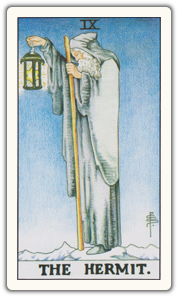
The Hermit marks inner light after experience—the moment you step back not to disappear, but to listen until your own truth becomes clear enough to carry.
If The Hermit shows up, don't assume the cards are telling you to cut everyone off, become a hermit forever, or that no one can help you. This card is about solitude that refines wisdom, reflection that improves character, and guidance that comes from lived experience—not isolation that hardens, punishes, or hides. It can feel quiet and clarifying. It can also expose where you are withdrawing without insight, or calling avoidance "spiritual." Both can be true at once.
This guide gives you a clear Hermit meaning you can use in a reading—without turning the card into a fortune-telling script or a lecture on suffering alone.
The Hermit in Plain Words
In plain words: some answers cannot be borrowed from noise, urgency, or other people's opinions. The Hermit asks you to create enough space to hear what you already know after you have lived through something—not to perform enlightenment, and not to punish yourself with endless loneliness. The work is to let reflection improve you, not to use silence as a wall.
Where Strength meets instinct and strong feeling with soft courage in relationship—to a partner, a colleague, the lion in your chest—The Hermit turns inward after that work. It is less about staying present with someone else's energy and more about finding the lantern you carry when no one else is in the room. Where The Wheel of Fortune tracks outer cycles, luck, and turns you cannot fully control, The Hermit asks what you do with your inner compass while the wheel still spins—what wisdom survives the ride.
What to Notice on the Card
- Lantern / inner light: truth earned through experience; guidance you can see in the dark without needing applause.
- Staff: a simplified wand—support for the path, not a spectacle; authority distilled to what helps you walk steadily.
- Mountain / elevated ground: solitude with perspective; distance chosen for clarity, not exile for its own sake.
- Cloak / hood: boundaries around the self while you listen inward; protection without pretending you feel nothing.
- Gray beard / elder figure: wisdom after time, not beginner enthusiasm; insight that includes what cost you something.
- Six-pointed star in the lantern: inner light as a practical beacon—small, steady, enough for the next step.
You don't need every symbol in every reading. Use the one or two that match your question.
Upright The Hermit Meaning
Core
Upright The Hermit says reflection can improve your character right now. Think of it as the capacity to pause long enough that your next move comes from inner truth—not from panic, people-pleasing, or the loudest voice in the group chat. That may look like a quiet weekend without scrolling, journaling before you reply to a hard message, asking for time to decide, or seeking counsel from someone whose wisdom you trust rather than from whoever speaks fastest.
This card often arrives after a season of motion, conflict, or learning. You may already sense that more input will not help until you integrate what happened. The Hermit favors solitude with purpose: not hiding from life, but stepping back so your values can catch up with your calendar. It supports the kind of wisdom that makes you kinder and clearer—not colder.
Compared with Strength, upright The Hermit is less about gentle courage with others or raw instinct in the moment and more about what you learn when the room gets quiet. Compared with The Wheel of Fortune, it is less about external change and timing in the world and more about the inner orientation you bring to whatever turn comes next.
Love
In love, upright The Hermit can point to needing space to know what you feel, slow courtship that respects pacing, or a relationship entering a reflective phase—less performance, more honesty. It may show one partner processing grief, identity, or past hurt before they can show up fully again. It can also celebrate mature affection: two people who do not need constant contact to trust the bond.
Read the pattern carefully. Are you taking healthy space to clarify your needs—or using "I need to work on myself" to avoid a necessary conversation? Is your partner honoring a pause, or are you being left in indefinite limbo without a return date? Upright The Hermit supports honest withdrawal with a purpose: one check-in, one boundary about timing, one request for clarity—not a verdict that love must always be distant or that you should wait forever without facts.
It can also mark spiritual compatibility—the kind of connection that deepens in quiet honesty rather than constant drama. Focus on what you can do: name what you are reflecting on, ask for the space you need in plain language, or offer patience when someone you care about is integrating a hard chapter.
Work
At work, upright The Hermit favors deep focus, mentorship sought from experience, research before launch, or stepping back from office noise to finish work that requires concentration. It suits sabbatical planning, skill-building away from the spotlight, consulting an elder practitioner, or declining meetings that exist only because everyone is afraid of silence.
If you are building a career, upright The Hermit reminds you that reputation also travels through judgment—what you say yes to when no one is watching, how you learn from a mistake before you promote the lesson. If you are facing burnout, ask whether you need more rest, more boundaries, or a quieter season to remember why the work mattered in the first place.
It can also support teaching, writing, counseling, or any role where your value comes from integrated experience rather than constant visibility. The Hermit here is wisdom offered sparingly and honestly—not disappearing from responsibility, but refusing to perform busyness as proof of worth.
Decision
When a decision is on the table, upright The Hermit leans toward the choice you can live with after quiet reflection—the path that still makes sense when the group chat goes silent. If the "yes" is only excitement, pressure, or fear of being alone, pause. If the "no" is only reflexive withdrawal from anything uncomfortable, pause for a different reason. Give yourself enough solitude to hear your own answer, then act.
One Next Step
Within 48 hours, take one reflective action with a boundary: one hour unplugged to journal, one walk without podcasts, one message asking for time before you commit, or one conversation with a trusted mentor—not a spiral of research that replaces deciding. Name what you are listening for, and what endless delay would cost.
Reversed The Hermit Meaning
Core
Reversed The Hermit often shows solitude out of balance. Common patterns: isolation without insight, withdrawal that blocks help, cynicism dressed as wisdom, becoming what hurt you, or "self-work" that never ends because it avoids re-entry. The card is less "you must never be alone" and more "your relationship with solitude needs recalibration."
Sometimes the imbalance is internal: you replay old pain until it becomes your personality, confuse numbness with peace, or treat every offer of support as an intrusion. Sometimes it is external: someone uses spiritual language to keep you at arm's length, or you use your lantern only to inspect everyone else's flaws while avoiding your own. Sometimes it is misread maturity: you call bitterness "realism," or you call loneliness "independence." Name which pattern fits before you swing to all-or-nothing conclusions.
Reversed The Hermit is not permission to force yourself back into noise before you are ready. It asks whether you need more insight, more connection, or both—and whether the mountain you climbed is giving you perspective or just keeping you alone.
Love
In love, reversed The Hermit can look like emotional unavailability framed as depth, ghosting labeled "healing," or staying single so long that fear wears the mask of standards. It can also show a partner who withdraws without explanation, or your own habit of punishing intimacy by disappearing whenever things get real.
Do not jump from this card alone to a verdict that you must chase someone or that the relationship is doomed. Read the pattern: where is solitude protecting you, and where is it hardening you? Where has past hurt taught you to become the person who hurt you—cold, absent, suspicious, or impossible to reach? Then choose one grounded action—send one honest check-in, set one return date after space, decline one more month of ambiguity, or ask for one session with a qualified counselor if withdrawal has become a lifestyle.
Work
At work, reversed The Hermit can mean hiding from feedback, hoarding knowledge to stay indispensable, analysis paralysis, or burnout from working alone without support. It may also show a culture that rewards lone-wolf heroics and punishes collaboration, or your own pattern of refusing mentorship because pride feels safer than learning.
If you cannot tell whether you are reflecting or avoiding, you are not in Hermit integrity yet—you are stuck in a loop. For career decisions, pause before taking a role that requires you to disappear from human contact, or before accepting isolation as the price of being "serious." Restore connection where it helps; then decide.
Decision
When deciding, reversed The Hermit warns against two traps: choosing delay because one past mistake convinced you that you cannot trust yourself, or choosing solitude because every option feels like a threat to your control. Ask whether the option requires you to cut off all help, mimic someone who harmed you, or call withdrawal wisdom when it is only fear. If any of those is true, fix the honesty gap before you commit.
One Next Step
Write three lines: what I am avoiding by staying alone, what insight I already have but will not act on, and one small step back toward honest contact this week. If the plan is only more silence, add one trusted person or one bounded conversation before you retreat again.
The Hermit as Yes / No
As a lean only: upright The Hermit often leans not yet—or yes only after reflection—take the time you need, seek counsel, clarify inner truth, then move. Reversed The Hermit often leans not yet—or no if the choice depends on staying isolated, blocking help, or repeating a hurtful pattern without insight. This is not a destiny stamp. Neighboring cards and real facts still matter.
Common Misreads
"The Hermit means I should cut everyone off."
No. The Hermit supports purposeful solitude that refines wisdom, not permanent exile or punishment of people who care about you. Healthy space has a reason and often a return point; isolation that hardens usually does not.
"This card is always about loneliness or being single."
Usually no. The image is inner light after experience—reflection, mentorship, integration, and truth you earned. Context can include romantic distance, but the core lesson is wise withdrawal, not a life sentence alone.
"Reversed Hermit means I am antisocial or broken."
Not always. It more often points to isolation without insight, withdrawal that blocks help, or becoming what hurt you—that needs diagnosis and repair. Sometimes the next step is reconnection or support, not more time on the mountain.
Mini Case Study
Question: "My ex wants to talk, but I feel raw. Should I respond this week?"
Pull: The Hermit, upright. What stands out: the lantern and the mountain. Read: you are allowed to need space; the question is whether the space is for clarity or for avoidance. Upright Hermit supports a bounded pause—not silence as a weapon. You do not owe an instant reply, but you may owe honesty about timing. Next step: send one message within 48 hours that names you need two weeks to reflect and will reach out by a specific date. That is Hermit energy without turning wisdom into disappearance.
Try This Today
Use this 5-line journal after you pull The Hermit:
- Question: Where do I need solitude that refines wisdom—not isolation that hardens—right now?
- Card: The Hermit — upright / reversed
- What I see: (lantern, staff, mountain, cloak, elder figure, star in lantern—pick what stands out)
- What it may mean in my situation:
- One next step in 48 hours:
Quick FAQ
What does The Hermit tarot card mean?
It points to inner light after experience—solitude that refines wisdom, reflection that improves character, and guidance from lived truth rather than noise. Quiet clarity, not permanent exile or emotional shutdown.
What does The Hermit mean in love?
Space to know what you feel, slow honest pacing, or mature affection that does not need constant performance. Upright favors purposeful reflection and clear communication about timing; reversed warns against withdrawal that blocks help, ghosting labeled healing, or becoming cold like someone who hurt you.
Is The Hermit a yes card?
It can lean not yet—or yes only after reflection—when the wise move is to pause, integrate, seek counsel, and then act. It is not a guarantee of outcome or a command to wait forever.
Is reversed The Hermit always bad?
No. It is a check on isolation without insight, withdrawal that blocks help, and solitude that hardens rather than clarifies—often useful, not purely negative. The work is to name which imbalance is present and adjust.
Keep Practicing
Want a simple daily structure for pulls like this? Start with the free 7-Day Tarot Reflection Guide, or use the Opal Arc Tarot Journal Starter for printable pages that keep your questions, cards, and next steps in one place.
Continue the dictionary: previous The Strength Tarot Card Meaning, next The Wheel of Fortune Tarot Card Meaning. Contrast soft courage with inner stillness via The Strength Tarot Card Meaning, practice with a first one-card tarot pull, or browse Card Meanings.