
Some days do not need a full routine. They need a way back to the surface. The inbox is loud, the room has collected small unfinished things, your phone has become a second weather system, and every task seems to arrive with three smaller tasks attached to it.
A gentle daily reset is not a productivity performance. It is a small structure for returning to yourself when life feels too full. The point is not to optimize the day, catch up perfectly, or become a person who never drops anything. The point is to lower the amount of friction between you and the next honest action.
This reset works best when it stays visible, tactile, and kind. It uses the home around you, the surfaces you touch, and a few written lines to help your attention stop scattering. You can use it in the morning, after work, before dinner, or on a Sunday afternoon when the week is starting to gather at the edge of your mind.
A useful reset does not ask you to become a new person. It gives the current version of you a softer place to begin.
Let the reset be small enough to repeat
The most common mistake is making the reset too complete. You decide to clear the whole room, answer every message, meal plan, wash your hair, reorganize a drawer, and become emotionally resolved before the kettle boils. That kind of reset can feel beautiful in theory and punishing in real life.
A better reset has a narrow job. It helps you see what is open, choose what matters next, and create one physical cue that says the day is allowed to become simpler. If you can finish it in ten to twenty minutes, you are more likely to return to it.
- Clear one visible surface, not the whole home.
- Choose one anchor for the next few hours, not a new life system.
- Write three lines, not a perfect plan.
- Close one open loop, not every source of tension.
- Prepare one soft landing for later, not an elaborate evening routine.
Begin with the surface that catches everything
Every home has a place where the day lands. It may be an entry table, a bedside chair, a desk corner, the kitchen counter, or the top of a dresser. This surface usually tells the truth before your calendar does. Keys, receipts, hair ties, half-open mail, a glass, a notebook, and a phone all gather where attention has been interrupted.
Start there. Do not organize the whole category of things. Simply return each object to a more helpful state. Put keys in a bowl. Stack paper in one pile. Turn the phone face down or move it to a charging place. Bring dishes to the sink. Leave only what belongs to the next part of the day.
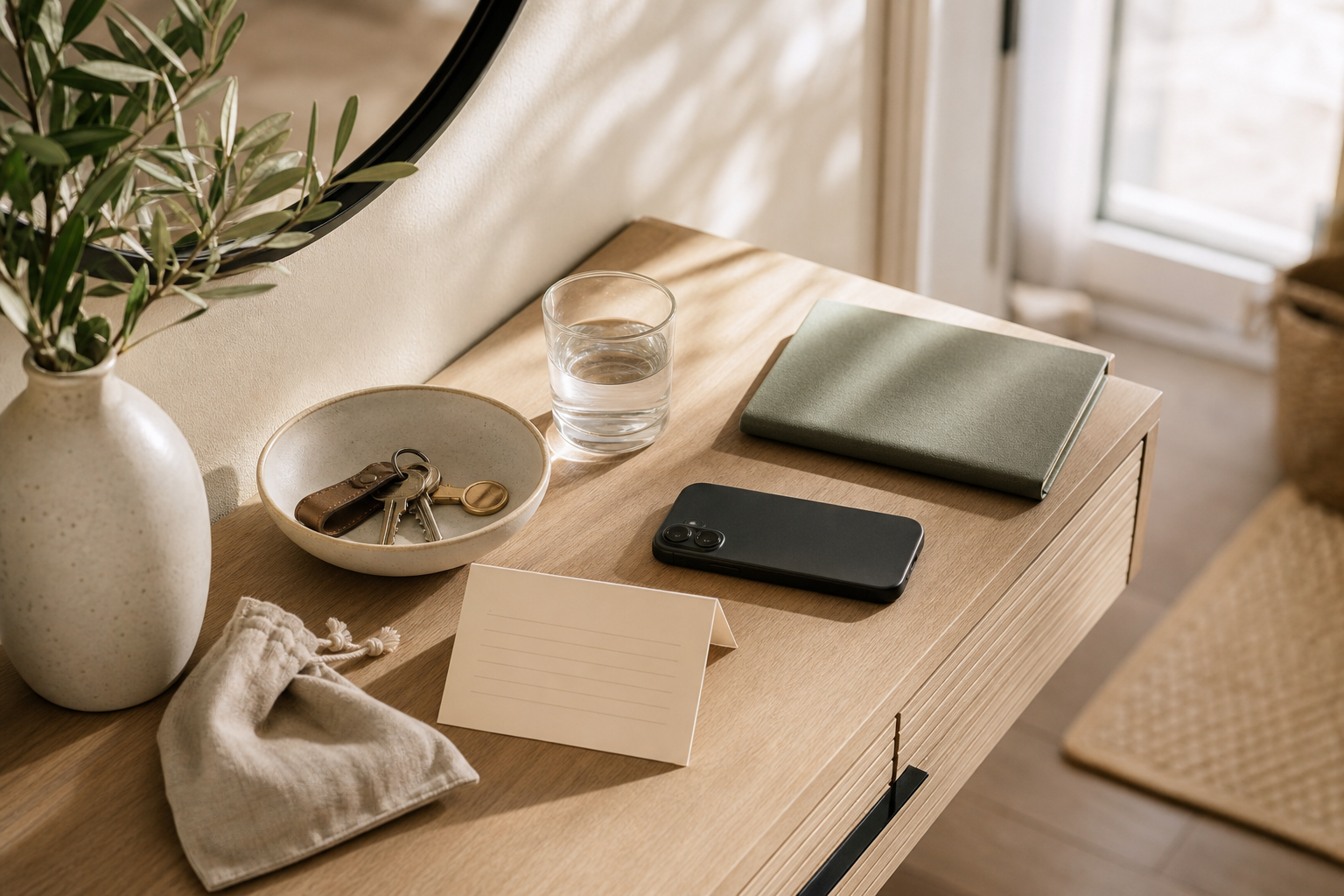
This is not about aesthetic perfection. It is about reducing visual noise enough that your nervous system stops reading the room as a list of small accusations. A cleared landing zone gives your attention a place to return.
Choose one anchor instead of rebuilding the whole day
When life feels too full, the mind often searches for a complete plan. It wants a new schedule, a better method, a full reset of priorities. Sometimes that is useful. Most days, it is too heavy.
Choose one anchor instead. An anchor is a simple action or condition that helps the next few hours feel less scattered. It should be specific enough to do today and gentle enough that you do not resist it.
- I will make the next meal simple and warm.
- I will answer only the two messages that keep blocking my mind.
- I will put my bag, keys, and tomorrow's first item in one place.
- I will stop adding tasks after 7 p.m.
- I will take ten quiet minutes before I make another decision.
The anchor is not a reward for finishing everything. It is the support that helps you stop treating the whole day as one large emergency.
Make one list that separates noise from next action
A full mind rarely contains only tasks. It holds errands, feelings, reminders, decisions, social pressure, things you forgot, things you are avoiding, and a few old thoughts wearing new clothes. A gentle reset gives those thoughts a place to land without turning every thought into an obligation.
Use one blank page. Draw no complex grid. Write three quiet headings:
- Open loops: anything unfinished that keeps calling for attention.
- Next actions: the few things that can actually move today.
- Not today: useful thoughts that do not deserve immediate access to your evening.
The third column is the mercy column. It lets you keep the thought without letting it run the day. You are not rejecting responsibility. You are refusing to let every possible responsibility arrive at once.
Lower the number of open loops
Open loops are tiring because they make the mind keep checking whether something has been handled. Many of them are small. A return to send. A tab left open. A text you need to answer. A document you need to find. A decision about dinner. A laundry basket that has become part of the furniture.
Choose one open loop that can be closed in less than five minutes. Send the answer. Place the return by the door. Move the laundry to the next step. Put the document in one folder. Decide that dinner will be simple. The point is not dramatic progress. The point is proof that the day can become less open.
If the loop is emotional or relational, do not force closure. Write the smallest truthful next step: ask for a time to talk, sleep before replying, name what you need to understand, or admit that you are not ready to decide. Some loops need care more than speed.
Build a soft landing for the evening
A daily reset becomes more powerful when it thinks ahead with kindness. Ask: what will make later feel less abrupt? This is not the same as controlling the whole evening. It is placing one supportive cue where your future self will meet it.

Maybe you fill a glass of water and leave it near your bed. Maybe you open the notebook to a blank page. Maybe you place tomorrow's first object where you will see it. Maybe you soften the lighting before the room becomes too harsh. For a more room-specific version of this idea, the warm bedroom ritual turns the end of the day into a fuller home practice.
Keep a two-minute closing page
At the end of the reset, write three sentences. They do not need to be elegant. They only need to tell your mind what has been noticed and what no longer needs to stay suspended.
- Today feels full because...
- The one thing I am choosing next is...
- The thing I am allowed to leave for later is...
This small closing page is especially helpful if you tend to carry tasks into the evening as a mood. The writing creates a boundary. It says: this has been seen, this has been chosen, and this can wait.
What to stop adding
A good reset also protects the day from new weight. When you feel a little clearer, it is tempting to add more. You might open another tab, start a new list, research a better planner, or decide that the reset should become a full system. Resist that urge.
The purpose of this practice is not to become more available to every demand. It is to help you stop handing your attention to whatever arrives most loudly. Let the reset end before it becomes another source of pressure.
- Do not add a second reset because the first one worked.
- Do not turn the page into a moral scorecard.
- Do not keep clearing surfaces after the useful friction has dropped.
- Do not use the reset to avoid rest, food, sleep, or a conversation that matters.
- Do not measure the day only by how much it produced.
A daily reset you can actually use
When you need the shortest version, use this:
- Clear one surface.
- Write every open loop in one place.
- Choose one anchor for the next few hours.
- Close one small loop.
- Leave one soft cue for later.
- Write what can wait.
The gentle daily reset is not here to make life look effortless. It is here to make the next step feel possible. On a full day, that is enough. A surface clears. A page receives the noise. One action becomes visible. The evening has somewhere softer to land.