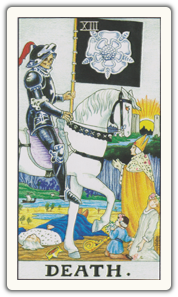
Death marks inevitable change that clears space for renewal—the moment a chapter closes so something honest can begin, and the question becomes how you meet the ending rather than whether change will arrive.
If Death shows up, don't assume the cards are predicting literal death, an accident, an illness diagnosis, or a doom sentence on someone you love. This card is about endings you can prepare for, transitions that release what is finished, and change that opens room for renewal—not a body-death stamp, a medical fortune dump, or proof that life is cruel. It can feel sober and clarifying. It can also expose where you are clinging to a form that no longer lives. Both can be true at once.
This guide gives you a clear Death meaning you can use in a reading—without turning the card into a fortune-telling script or a lecture on loss you cannot survive.
Death in Plain Words
In plain words: some seasons end whether you approve or not. Death asks you to meet the close with honesty—release what is finished, grieve what mattered, and stop forcing continuity past its natural boundary. The work is to let the ending clear space, not to treat every transition as catastrophe or to pretend nothing needs to change.
Where The Hanged Man suspends action so you can see from a new angle, Death is the chapter close that follows enough seeing—the pause ends, the old form is done, and movement resumes through transition rather than through more hanging. Where The Tower is the sudden shock that breaks a false structure without warning, Death is the ending you can often feel approaching: a role ending, an identity shedding, a relationship phase completing, a habit dying so a healthier one can replace it. The Hanged Man changes the view; Death closes the book; The Tower is the lightning strike—not the same card, and not interchangeable.
What to Notice on the Card
- Skeleton knight / Death rider: change that arrives without negotiation; the messenger of transition, not a verdict on your worth or lifespan.
- Black banner with white rose: endings that still carry beauty; transformation and release, not destruction for its own sake.
- White horse: movement through transition; the close is already in motion—you meet it or you are dragged.
- King, priest, woman, child: no rank, role, or life stage escapes change; what ends may touch status, faith, family, or innocence alike.
- River / boat: passage between states; what crosses over does not return unchanged—grief, identity, or circumstance on the far bank.
- Sunrise between towers: dawn after the close; renewal waiting on the other side of release if you stop blocking the passage.
You don't need every symbol in every reading. Use the one or two that match your question.
Upright Death Meaning
Core
Upright Death says change has arrived—or is close enough to name—and the wise move is to meet the ending instead of bargaining with a season that is already over. Think of it as the capacity to release what is finished, honor what it gave you, and stop investing energy in a form that no longer carries life. That may look like resigning from a role that drained you, ending a situationship that will never become honest, clearing out belongings that belong to an old identity, or admitting that a strategy worked once and does not work now.
This card often arrives when you already sense the close. You may have outgrown the job title, the friend group dynamic, the coping pattern, or the story you tell about who you are. Upright Death favors endings with dignity: not melodrama, not ghosting without grief, and not pretending you can keep every piece exactly as it was. It supports transition that clears space—so renewal has somewhere to land.
Compared with The Hanged Man, upright Death is less about voluntary pause and suspended seeing and more about the close itself—the chapter is done, and the question is how you exit. Compared with The Tower, it is less about sudden external shock and more about change you can often prepare for: the ending you feel approaching, not the bolt from the blue.
Love
In love, upright Death can point to a relationship phase ending, a pattern dying so something healthier can form, or the honest close of a connection that has run its course. It may show two people transitioning from romance to friendship, from intensity to steadiness, or from denial to truth. It can also mark the end of a fantasy—the version of a person you needed them to be, or the story that love would fix what you have not faced alone.
Read the pattern carefully. Are you naming a necessary ending—or using "it's over" language to avoid one hard conversation? Is the relationship actually finished, or is one behavior ready to die while the bond could survive if both people change? Upright Death supports honest closure: one clear conversation, one boundary about what will not continue, one ritual of release—not cruelty dressed as fate or silence dressed as maturity.
It can also celebrate transformation inside a lasting bond—the death of jealousy, of scorekeeping, of performing a role that never fit. Focus on what you can do: name what is ending, grieve it without dragging everyone through endless renegotiation, or ask for the truth about whether you are building something new or prolonging something dead.
Work
At work, upright Death favors role transitions, project sunsets, career pivots, or retiring a method that no longer serves the team. It suits handing off responsibilities cleanly, archiving work that is done, leaving a job with integrity, or killing a product line that survives only because no one wants to disappoint the founder.
If you are building a career, upright Death reminds you that identity is not frozen in a title—what you release may make room for work that fits who you are now. If you are facing layoffs, restructuring, or industry shift, ask what is actually ending and what skill or relationship can travel with you to the next chapter.
It can also support necessary cuts: stop the campaign that flatlined, end the meeting that exists only from habit, or decline the promotion that would bury you in a life you do not want. Death here is professional hygiene—not burning bridges for drama, but refusing to pretend a dead initiative is still alive.
Decision
When a decision is on the table, upright Death leans toward the choice that honors the ending—the path that stops forcing continuity with what is already finished. If the "yes" is only fear of the unknown, pause and name what you are afraid to lose. If the "no" is only nostalgia for a version of yourself that no longer fits, that may be Death asking you to release, not to stay. Choose the option that clears space honestly, then act.
One Next Step
Within 48 hours, take one closure action with a boundary: write one sentence naming what is ending, remove one object or calendar block tied to the old chapter, send one honest message about a transition, or schedule one conversation you have been postponing—not a dramatic burn, but a clean close you can stand behind. Name what you are releasing, and what you want room for next.
Reversed Death Meaning
Core
Reversed Death often shows resistance to an ending that is already trying to happen. Common patterns: clinging to a role, relationship, or identity past its season; forcing continuity because change feels like failure; rebooting a stuck chapter without doing the grief or accountability work; or treating every transition as catastrophe so you freeze instead of move. The card is less "nothing will ever change" and more "you are blocking the change that would free you."
Sometimes the imbalance is internal: you know the job is over but keep refreshing the inbox as if loyalty could resurrect it, or you replay a breakup until the pain becomes your whole personality. Sometimes it is external: someone refuses to let a dynamic evolve, or a system keeps a dead policy alive because no one wants to be the person who said stop. Sometimes it is misread fear: you call prudence "commitment" when you are actually afraid of the empty room after release. Name which pattern fits before you swing to all-or-nothing conclusions.
Reversed Death is not permission to burn everything down for drama. It asks whether you need to accept the ending, complete the transition, or reboot with honesty—and whether the chapter you are forcing to continue is already closed.
Love
In love, reversed Death can look like staying in a relationship because leaving feels like admitting defeat, returning to an ex out of habit rather than renewal, or refusing to let a harmful pattern die while insisting the love is "real." It can also show a partner who will not acknowledge that something has shifted—ghost levels of distance while the label stays, or emotional stagnation dressed as stability.
Do not jump from this card alone to a verdict that you must break up today or that the relationship is doomed. Read the pattern: what is actually over, and what are you forcing to stay alive? Where is fear of grief keeping you in a form that no longer nourishes anyone? Then choose one grounded action—name one behavior that must end, set one deadline for an honest decision, decline one more month of ambiguity, or ask for one session with a qualified counselor if you cannot tell clinging from commitment.
Work
At work, reversed Death can mean refusing to sunset a failing project, staying in a role out of sunk-cost loyalty, or rebranding the same dead strategy with new slides. It may also show a culture that punishes endings—where leaving is betrayal and killing an initiative is treated as disloyalty even when the work no longer serves anyone.
If you cannot tell whether you are persevering or prolonging, you are not in Death integrity yet—you are stuck in a loop. For career decisions, pause before taking a role that requires you to pretend a department is healthy when everyone knows it is not, or before accepting that "we have always done it this way" is reason enough to continue. Complete the transition where it is due; then decide what belongs on the other side.
Decision
When deciding, reversed Death warns against two traps: choosing to stay because one past ending hurt so much that you treat all change as enemy, or choosing forced continuity because the empty space after release feels unbearable. Ask whether the option requires you to deny an ending everyone else can see, reboot without learning from what died, or call stagnation loyalty. If any of those is true, fix the honesty gap before you commit.
One Next Step
Write three lines: what I already know is ending, what I am doing to keep it on life support, and one small release I can allow this week. If the plan is only more forcing, add one honest conversation or one boundary that stops pretending the old chapter is still open.
Death as Yes / No
As a lean only: upright Death often leans yes when yes means let this end, accept the transition, or choose change that clears space—release what is finished, then move. Reversed Death often leans not yet—or no if the choice depends on forcing continuity, denying an ending that is already present, or rebooting a stuck chapter without honest closure. This is not a destiny stamp. Neighboring cards and real facts still matter.
Common Misreads
"Death means someone is going to die."
No. In practical readings Death points to endings, transitions, and change that clears space—roles, phases, habits, identities—not literal body death, accidents, or illness predictions. If health is the question, consult qualified care; do not treat this card as a medical verdict.
"This card is always terrible news."
Usually no. Endings can hurt and still be necessary. The white rose on the banner and the sunrise between towers remind you that release can carry beauty and open room for renewal. Death is often the honest close you needed, not a punishment.
"Reversed Death means nothing will ever change."
Not always. It more often points to resisting an ending, forcing continuity past its season, or rebooting without grief work—that needs diagnosis, not doom or false comfort. Sometimes the next step is to accept the close; sometimes it is to complete the transition you have been postponing.
Mini Case Study
Question: "Should I stay in my job another year for the bonus, even though I know I'm done?"
Pull: Death, upright. What stands out: the white horse and the sunrise between towers. Read: the chapter is already closing in you—the bonus may not buy back the cost of forcing continuity. Upright Death supports a dignified transition, not a dramatic quit with no plan. You do not owe the company a public meltdown, but you may owe yourself honesty about the exit timeline. Next step: within 48 hours, write one page on what would need to be true for you to stay six more months—and one concrete step toward leaving well if those conditions are not met (update resume, one networking message, or a conversation with a trusted mentor about timing).
Try This Today
Use this 5-line journal after you pull Death:
- Question: What chapter is ending—or asking to end—and how am I meeting it?
- Card: Death — upright / reversed
- What I see: (skeleton knight, black banner with white rose, white horse, figures at every life stage, river/boat, sunrise between towers—pick what stands out)
- What it may mean in my situation:
- One next step in 48 hours:
Quick FAQ
What does The Death tarot card mean?
It points to inevitable change that clears space for renewal—endings you can prepare for, transitions that release what is finished, and how you meet the close rather than whether change will arrive. Chapter close, not literal body death.
What does Death mean in love?
A phase ending, a pattern dying so something healthier can form, or honest closure when a connection has run its course. Upright favors dignified release and truth about what is over; reversed warns against clinging past the season, forcing continuity, or rebooting without grief work.
Is Death a yes card?
It can lean yes when yes means let this end, accept the transition, or choose change that clears space. It is not a guarantee of outcome or a command to destroy what still lives—context and neighboring cards still matter.
Is reversed Death always bad?
No. It is a check on resisting necessary endings, forcing continuity past its season, and treating every transition as catastrophe—often useful, not purely negative. The work is to name what you are blocking and choose an honest next step.
Keep Practicing
Want a simple daily structure for pulls like this? Start with the free 7-Day Tarot Reflection Guide, or use the Opal Arc Tarot Journal Starter for printable pages that keep your questions, cards, and next steps in one place.
Continue the dictionary: previous The Hanged Man Tarot Card Meaning, next Temperance Tarot Card Meaning. Contrast sudden shock with chapter close via The Tower Tarot Card Meaning, practice with a first one-card tarot pull, or browse Card Meanings.